Why Your Sleep Needs Changed in Your Thirties and Your Schedule Didn't
Quick Answer: The hours you need barely change in your thirties — seven to nine remains the adult range. What changes is everything around them: deep slow-wave sleep declines gradually from your twenties onward, your circadian system gets less flexible about irregular timing, caffeine and alcohol interfere more, and the decade’s life load — career peak, small children, aging parents, a phone that never stops — fragments the night precisely when it has less depth to spare. The upgrade is not more time in bed; it is consistency, an anchored wake time, and treating the old recovery tricks as retired.
Here is what actually changed, why the same short night costs double now, and the schedule renovation that fits a real life.

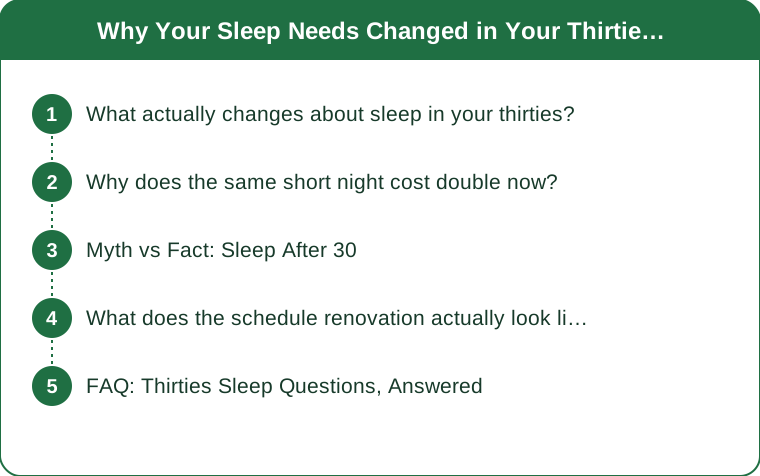
What actually changes about sleep in your thirties?
Four quiet shifts, none of them a malfunction.
Deep sleep starts its long taper. Slow-wave sleep — the physically restorative stage that dominates the first half of the night — peaks in adolescence and declines gradually through adulthood, with the slide already measurable in your thirties. You still sleep; the architecture just carries proportionally less of its deepest phase, which is why the same seven hours can feel less refreshing than the college version did.
The circadian system loses flexibility, not function. The twenty-something body absorbed 2am nights and noon recoveries with barely a mark. The thirties clock holds rhythm fine — but punishes irregularity harder: the Sunday sleep-in now buys a Monday-morning fog, and shifting bedtime around erodes quality in a way it visibly did not a decade ago.
Chemistry interference grows. Caffeine’s half-life meets earlier alarms and accumulated sensitivity; the 4pm coffee that once vanished now leaves a fingerprint on sleep onset. Alcohol fragments the second half of the night more noticeably — the two-glass evening that used to cost nothing now buys a 3am wake-up and a flattened morning.
And the load peaks exactly now. Career responsibility, young children, a household, parents starting to need you, and a notification stream with no closing time — the decade concentrates interruption pressure on a night that has less depth to absorb it. The sleep did not break. The margin around it disappeared.
Why does the same short night cost double now?
Because the buffers that hid the cost are gone.
The debt math compounds against a fuller ledger. A short night degrades attention, mood, and reaction time at any age — but a twenty-five-year-old’s Tuesday often had slack to absorb it. The thirties Tuesday runs at capacity: meetings that need your judgment, a commute, a school pickup, decisions with stakes. The same cognitive dip lands on a day with no room for it, so it reads as a bigger dip.
Recovery windows shrank. The nap died with the open afternoon; the weekend lie-in died with Saturday sports and errands. Sleep debt that once cleared in a lazy Sunday now rolls forward into the week, and rolled-forward debt is what turns one bad night into a bad stretch.
Fragmentation multiplies the loss. A seven-hour night broken twice — a child, a worry, a phone — delivers meaningfully less restorative value than seven unbroken hours, because each wake-up resets the descent toward deep stages. The thirties specialise in exactly this pattern: enough total time, not enough continuous time.
Stress physiology joins in. The decade’s ambient load raises evening arousal — the revving mind at 11pm — which delays onset, and delayed onset against a fixed alarm is pure subtraction from the night’s restorative front half.
None of this argues you are aging badly. It argues the strategy has to change: the twenties ran on resilience, and the thirties run on consistency — which, fortunately, is a skill rather than a gift.

Myth vs Fact: Sleep After 30
Myth: You need less sleep as you get older. Fact: Need stays in the seven-to-nine range through adulthood; what declines is the ability to get it — depth, continuity, and schedule tolerance. Mistaking reduced ability for reduced need is how chronic mild deprivation gets normalised.
Myth: You can bank sleep on weekends. Fact: Catch-up sleep repays part of the debt and helps — but it does not fully restore performance, and late weekend mornings shift your clock so Sunday night fails and Monday inherits it. Partial credit, real interest.
Myth: Eight hours is the universal target. Fact: The range is seven to nine, individual and fairly stable. The honest test is a week of consistent timing without an alarm cutting you short — where you naturally land is your number, and forcing nine on a seven-hour body just manufactures 5am staring.
Myth: Naps ruin night sleep. Fact: Timing decides. A twenty-minute nap before mid-afternoon is a clean performance tool; the 6pm hour-long collapse steals pressure from the night. In a fragmented-sleep decade, the short early nap is one of the few twenties tools that survives.
Myth: Lying in bed longer means more sleep. Fact: Extending time in bed without extending sleep trains the bed to host wakefulness — the classic insomnia loop. If you are awake past twenty-odd minutes, getting up briefly with dim light and low stimulation resets the attempt better than heroic stillness.
What does the schedule renovation actually look like?
Five moves, ranked by return on effort.
1. Anchor the wake time — seven days. One fixed wake-up, weekends within thirty to sixty minutes of weekdays, is the single highest-yield change available. The consistent anchor stabilises the entire rhythm behind it: sleep onset, deep-sleep timing, morning alertness. Everything else in the renovation leans on this beam.
2. Set the caffeine curfew by counting backwards. Give yourself eight to ten hours between the last caffeine and bedtime — for a 10:30 bedtime, that ends the coffee window by early afternoon. Keep the morning ritual whole; relocate the emotional late-afternoon cup to decaf or tea and the 3am audit disappears within a week.
3. Get honest about alcohol’s second half. Not prohibition — accounting. Evening drinks fragment the back half of the night and suppress its quality; moving them earlier, lighter, or to nights before flexible mornings keeps the social life and drops the recurring 3:30 wake-up.
4. Build a wind-down that survives your actual house. Ten minutes is enough if it is consistent: lights lower, screens parked or dimmed, tomorrow’s first task written down to stop the 11pm rehearsal loop, and something analog — pages of a book, stretching on the floor, the dishwasher’s closing ritual. The cue sequence matters more than the contents.
5. Keep the room on the season’s side. Late-August bedrooms hold heat; sleep onset wants a cool room, dark enough that the streetlight is not a variable. A fan, shades, and lighter bedding are cheap architecture for the front half of the night.
And know the line between renovation and referral: loud snoring or gasping, three-plus weeks of insomnia that resists the basics, restless legs, or daytime sleepiness that intrudes on driving belong to a clinician — sleep disorders concentrate in exactly this decade and respond well to actual treatment. This is general information, not medical advice.
FAQ: Thirties Sleep Questions, Answered
Why do I wake at 3am more than I used to?
The usual suspects stack: alcohol metabolising, caffeine still on board, evening stress arousal, and lighter second-half sleep architecture. Run the curfews and the wind-down for two weeks before assuming something deeper; if 3am persists with racing thoughts, brief get-up-and-reset beats lying in the audit.
Is 6.5 hours enough if I feel okay?
Feeling okay adapts faster than performance does — chronic mild short sleep dulls the gauge that would report it. Test yourself honestly: a week of consistent timing with a real seven-plus opportunity, then compare afternoon energy and mood. Most people discover the difference they had stopped noticing.
Do sleep trackers help or just add anxiety?
They are decent at timing and consistency — the two variables that matter most this decade — and rough at staging. Use the trend lines to enforce your anchor and curfews; ignore nightly deep-sleep scores, and retire the tracker for a while if the score itself starts costing you sleep.
How do parents of young kids apply any of this?
Control the controllables: the anchored wake time, the caffeine curfew, and a wind-down that doubles as the household’s lights-down routine. Fragmentation from kids is a season, not a failure — protect continuity where possible, split night duty into shifts so each adult gets one unbroken block, and let the short early nap earn its keep on the roughest days.
TL;DR:
- The need — seven to nine hours — did not change; deep-sleep share, schedule tolerance, and chemical margins did, while the decade’s load peaked.
- Short nights cost double now because the buffers are gone: no naps, no lie-ins, full-capacity days, and fragmentation resetting the night’s restorative descent.
- Renovate in order: one anchored wake time seven days a week, an eight-to-ten-hour caffeine curfew, honest alcohol accounting, a ten-minute wind-down, a cool dark room.
- Weekend catch-up is partial credit with interest; snoring, month-long insomnia, or intrusive daytime sleepiness goes to a clinician.
Pick the anchor wake time tonight and hold it through the weekend. One consistent beam carries more of the decade’s sleep than every gadget combined.
Keep Reading
This article is for general informational purposes only and is not medical advice. Always consult a qualified health professional for guidance specific to you.