What Actually Changes About Training in Your Thirties, and What Does Not
Quick Answer: Very little about your capacity changes in your thirties. What changes is recovery speed, tissue tolerance for sudden load increases, and above all the amount of life competing for your training time. Strength and endurance both remain highly trainable, and most of what people attribute to age in this decade is actually sleep debt, stress, and inconsistency.
You keep reading that everything falls apart after thirty, and also that age is just a number, and neither matches what you are experiencing.
What is actually happening is more specific and considerably more useful than either version.

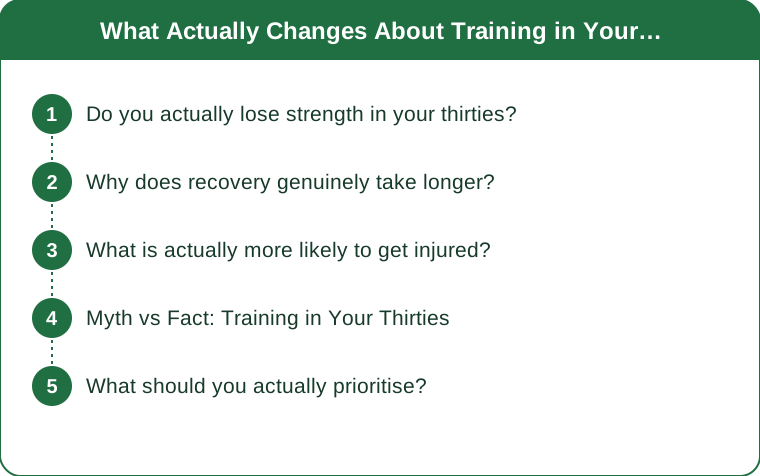
Do you actually lose strength in your thirties?
Not meaningfully, if you train.
Age-related muscle loss is real and it becomes clinically significant later, typically from the forties and fifties onward, and it is heavily modified by activity. In an untrained person, gradual decline through the thirties is common. In someone doing resistance training, strength typically continues to increase through this decade.
Many strength athletes peak in their thirties. That is not an exception, it is what the training data shows for strength-dominant sports.
So the honest answer is that strength is not the thing that changes. If you are getting weaker in your thirties, the most likely explanations are less training, less sleep, less food, or more stress - all of which are what actually happens to most people in this decade, and all of which are addressable.
Should I train differently than I did at 25?
Yes, but not less. The main change is a longer warm-up and more gradual progression rather than a lower ceiling.
Is it too late to start lifting at 35?
No. Untrained people starting resistance training in their thirties make rapid gains, in some cases faster than experienced lifters, because there is more room to improve. This is one of the most consistent findings in the field.
Why does recovery genuinely take longer?
Because several small things slow slightly, and one large thing usually gets much worse.
The physiological changes are modest in this decade. Tissue turnover slows somewhat, and the inflammatory response to hard training resolves a little more slowly.
The non-physiological change is enormous, and it is sleep. Career demands, young children, and general life load hit hardest between 30 and 45, and sleep is the single largest driver of recovery there is. A 35-year-old sleeping six broken hours will recover far worse than a 25-year-old sleeping eight, and almost none of that difference is age.
Stress works the same way. Elevated chronic stress impairs recovery, and this decade is typically the highest-stress stretch of adult life.
How much recovery time do I actually need between hard sessions?
Most people in their thirties do well with 48 hours between hard sessions targeting the same tissue, which is not far off what they needed at 25. What changes is how much a bad week of sleep costs you.
Should I take more rest days?
Usually the better adjustment is to make easy days genuinely easy rather than adding rest days. Most people in this decade train too hard on their easy days and too easy on their hard ones, and that pattern costs more than any age effect.

What is actually more likely to get injured?
Tendons and connective tissue, and specifically in response to sudden increases in load.
Tendon adapts more slowly than muscle at any age, and that gap widens somewhat with time. Muscle can get stronger faster than the tendon attaching it can adapt, which is why the classic thirties injury is not a dramatic tear but an Achilles, patellar, or shoulder tendon problem that arrives six weeks into a new programme.
The trigger is almost always the same: a sudden increase in volume, intensity, or a new movement pattern, particularly after a period of reduced activity.
Tissue tolerance is also more sensitive to how warm you are, which is why this matters more from autumn onwards, and why the first cold month of the year produces a spike in soft tissue injuries across every sport.
What is the single best injury prevention measure?
Gradual progression. Increasing training load by a modest amount week to week, rather than jumping, prevents more injuries than any warm-up protocol or piece of equipment.
Do I need a longer warm-up now?
Yes, and it is one of the few genuinely age-related changes worth making. Adding five minutes of gradual, progressive warm-up is cheap insurance and it becomes more valuable every year.
Is it worth seeing a physio before something hurts?
Many people find one assessment useful for identifying asymmetries and old injury patterns. This is general information rather than medical advice, and persistent pain should always be assessed rather than trained through.
Myth vs Fact: Training in Your Thirties
Myth: Your metabolism slows down significantly in your thirties. Fact: Large studies of total energy expenditure suggest metabolic rate is remarkably stable from around age 20 to 60 once body composition is accounted for. The weight changes people attribute to metabolism in this decade are far more likely to come from reduced daily movement and changed eating patterns.
Myth: You should switch to lighter weights and higher reps. Fact: Heavy strength training remains appropriate and beneficial, and is particularly valuable for bone density, which becomes a genuine consideration for women in the decades ahead. The technique and progression matter more than the load.
Myth: High intensity work is risky now. Fact: It remains valuable and it needs more of a ramp-in. The risk comes from doing it without a base rather than from doing it at all.
Myth: Soreness that lasts longer means you are getting older. Fact: It more often means you did something novel, or you are underslept or underfed. Novel movements produce more soreness at any age.
Myth: You need supplements you did not need before. Fact: For most people, sleep, protein intake, and consistency dwarf anything on a supplement shelf. Protein needs are frequently under-met by active women in this decade, and that is worth addressing before anything else.
What should you actually prioritise?
Five things, in order of return.
Sleep, seriously. It is the highest-leverage variable and the one most degraded in this decade. Protecting seven hours does more for training than any programme change.
Consistency over intensity. Three moderate sessions a week for a year beats six brilliant weeks followed by a lay-off, and the pattern of the thirties is exactly that boom-and-bust cycle.
How do I stay consistent with a full life?
Shorter sessions, scheduled like meetings, and a programme that survives a missed week. Thirty minutes three times a week, done for a year, outperforms an ambitious plan abandoned in March.
Protein and food. Active women commonly under-eat protein, and it matters for recovery and for maintaining muscle. This is general nutrition information rather than personal advice.
A longer warm-up and gradual progression. The two genuinely age-related adjustments worth making.
Strength training specifically. If you do one thing, do this. It maintains muscle and bone, supports everything else you do, and is the modality whose benefits compound most over the decades ahead.
What if I am starting from nothing?
Start smaller than you think and progress slower than you want. The most common failure mode for a 35-year-old returning to training is doing a 25-year-old’s first week, and the resulting injury or exhaustion ends the attempt.
Does any of this change again in my forties?
Some of it, and less dramatically than the internet suggests. The habits built now - strength work, sleep, gradual progression - are precisely what carries forward, which is why this decade matters more for what you build than for what you lose.
TL;DR:
- Strength and endurance remain highly trainable through your thirties, and many strength athletes peak in this decade.
- Recovery slows a little physiologically and a great deal because of sleep debt, stress, and life load.
- Tendons adapt more slowly than muscle, so sudden jumps in training load are the main injury risk.
- Metabolic rate is far more stable than the popular story suggests - reduced daily movement is the more likely explanation.
- Prioritise sleep, consistency, protein, a longer warm-up, and strength training specifically.
Most of what gets blamed on being in your thirties is a sleep problem, a consistency problem, or a progression problem wearing a convincing disguise. All three are fixable, and none of them get less fixable next year.
Keep Reading
This article is for general informational purposes only and is not medical advice. Always consult a qualified health professional for guidance specific to you.