Why You Need a Longer Warmup in Your Thirties Than Your Twenties
Quick Answer: Tendons and fascia become less elastic and slower to hydrate with age, and the change is measurable well before 40. Nothing about your capacity has collapsed — the on-ramp got longer. A warmup that worked at 22 in five minutes usually needs 10 to 15 minutes now, with more progressive loading and less static stretching.
You can still do the workout.
But the first set feels foreign in a way it never used to, your knees complain for the first ten minutes of a run, and something in the hip needs a few minutes of convincing.
This is a warmup problem being read as a fitness problem.

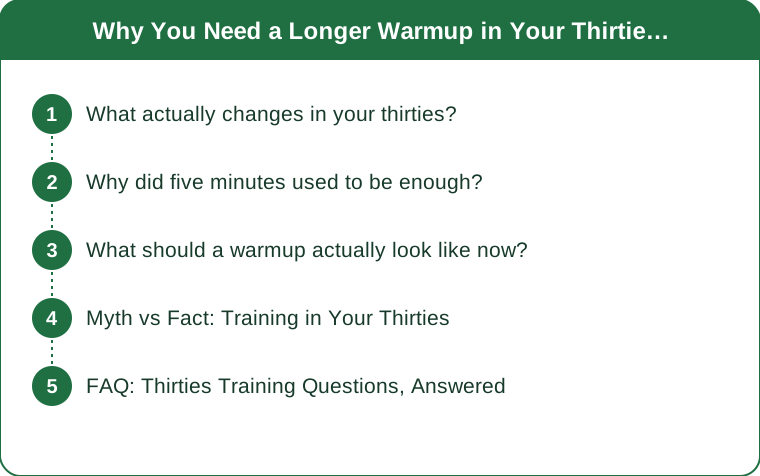
What actually changes in your thirties?
Several things, none of them dramatic on their own.
Tendon stiffness increases. Tendons store and release energy, and with age they become progressively stiffer and slower to respond. This is why the first few minutes of any springy activity — running, jumping rope, plyometrics — feel notably worse than the tenth minute.
Synovial fluid takes longer to distribute. Joints lubricate through movement, not passively. That process is not instant, and it becomes less instant. The clicking or catching in the first few minutes that vanishes afterwards is largely this.
Muscle temperature matters more. Warm muscle is more compliant and produces force more efficiently. The temperature rise itself has not changed much, but the penalty for skipping it has, because stiffer connective tissue makes cold loading feel worse.
Recovery timelines lengthen slightly. Protein synthesis response to training is a little blunted, and sleep quality typically declines through the thirties, which affects recovery independently. So you arrive at a session with a bit more residual fatigue than you used to.
What has not meaningfully changed at 32 or 36: your ability to build strength, your ability to build endurance, or your ceiling. Those decline much later and much more slowly than the internet implies.
Why did five minutes used to be enough?
Because at 22 the tissue was compliant enough that the first working set doubled as the warmup.
A more elastic tendon reaches useful stiffness quickly. A more responsive joint lubricates in a couple of minutes. So the traditional approach — two light sets, then go — was not good programming, it was getting away with it.
What changes in your thirties is the size of the gap between cold tissue and ready tissue. Same destination, longer path.
There is also a training-history factor that gets blamed on age. By your thirties you have probably accumulated a handful of minor injuries — an ankle roll, a tweaked back, some shoulder thing from years ago. Those sites are locally stiffer and need more specific preparation. That is history, not aging, and it responds well to targeted work.

What should a warmup actually look like now?
Four phases, 10 to 15 minutes total. It is not more exercise; it is a redistribution of the time you already spend.
1. Raise, 3 to 5 minutes. Easy cycling, brisk walking, rowing. The goal is a genuine temperature rise — you should be lightly sweating by the end. This is the phase people skip and it is the one that changes the most.
2. Mobilize, 3 to 4 minutes. Dynamic movement through the ranges you are about to use. Leg swings, hip circles, cat-cow, band pull-aparts, deep squat holds with rotation. Movement, not holding.
3. Activate, 2 to 3 minutes. Light targeted work for whatever tends to go quiet on you — glute bridges, band walks, scapular work, calf raises. This is where the old-injury sites get their attention.
4. Potentiate, 3 to 5 minutes. Ramp into the actual movement. For a squat day, that means empty bar, then 40 percent, then 60 percent, then 80 percent before your working weight. For a run, a few minutes of easy jogging with two or three short accelerations.
One cut worth making: long static stretching before training. Holding a stretch for 60 seconds or more can temporarily reduce force output, and it does not prepare tissue the way movement does. Save the long holds for after, or for a separate session.
Myth vs Fact: Training in Your Thirties
Myth: You need to train less in your thirties. Fact: You need to warm up more and recover more deliberately. Training volume tolerance in your thirties is close to your twenties; what changes is how much you can get away with skipping around the edges.
Myth: Stiff in the morning means you need more stretching. Fact: Morning stiffness is largely about fluid distribution and it resolves with movement. If stretching feels like it helps, it is probably the movement doing the work, not the hold.
Myth: Heavy lifting becomes risky after 30. Fact: Resistance training is one of the strongest protective factors for bone density and tendon health across the decades. What matters is progression rate and warmup quality, not the weight on the bar.
Myth: Soreness two days later means you overdid it. Fact: Delayed soreness peaking at 24 to 48 hours is normal and correlates poorly with either damage or effectiveness. A new movement will always produce more of it, at any age.
Myth: It is all downhill from here. Fact: Measurable decline in strength and aerobic capacity for trained people is roughly 1 percent per year starting around 40 — and training reliably outpaces that for years. The average untrained 40-year-old is far weaker than a trained one, and that gap is the actual variable.
FAQ: Thirties Training Questions, Answered
Is 15 minutes of warmup worth it if my session is only 45 minutes?
Yes, and it usually improves the session enough to pay for itself. If time is genuinely fixed, cut a set from your last exercise rather than cutting the ramp-up — the last set of the day contributes less than a proper warmup does.
What about early morning workouts?
Morning training needs the longest on-ramp, because you have been horizontal for eight hours and both temperature and fluid distribution are at their daily low. Add three to five minutes to the raise phase and expect your first working set to feel heavier than it does in the evening.
Do I need to warm up for a walk or easy yoga?
No. Low-intensity activity is its own warmup — that is precisely what makes it low intensity. The ramp matters for loading and speed: lifting, running, sport, plyometrics.
How do I know my warmup is long enough?
Use the first working set as the test. If it feels notably harder than the second, your warmup was short. A good ramp makes set one and set two feel roughly the same.
Should I be doing anything different for recovery?
Sleep is the highest-leverage change in your thirties, because it declines quietly and affects everything else. Beyond that, protein spread across the day and one genuinely easy day per week do more than any supplement. This is general information, not medical advice — persistent joint pain deserves a professional assessment.
TL;DR:
- Tendons get stiffer and slower to respond in your thirties, so the gap between cold and ready gets wider.
- Five minutes worked at 22 because elastic tissue warmed up fast — that was getting away with it, not good programming.
- Use 10 to 15 minutes: raise until lightly sweating, dynamic mobility, activation for old injury sites, then ramp into the movement.
- Skip long static stretching before training, and give morning sessions the longest on-ramp of all.
Your capacity did not drop in your thirties. Your on-ramp got longer, and nobody sends a memo about it.
Keep Reading
This article is for general informational purposes only and is not medical advice. Always consult a qualified health professional for guidance specific to you.