Why Summer Heat Hits Harder in Your Thirties: Questions Answered
Quick Answer: Physiological heat tolerance changes very little between the twenties and thirties in trained people. What changes is context: less sleep, more life load, more sedentary time in air conditioning, and less consistent heat exposure, all of which slow acclimatisation. Add slower recovery between hot sessions and the same summer feels harder without anything having declined. Most of it is addressable.
Here are the questions people actually ask, answered one by one.
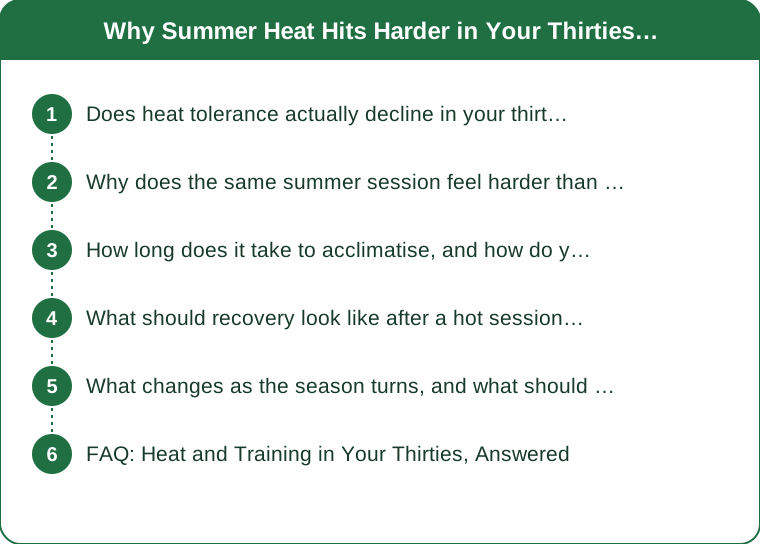
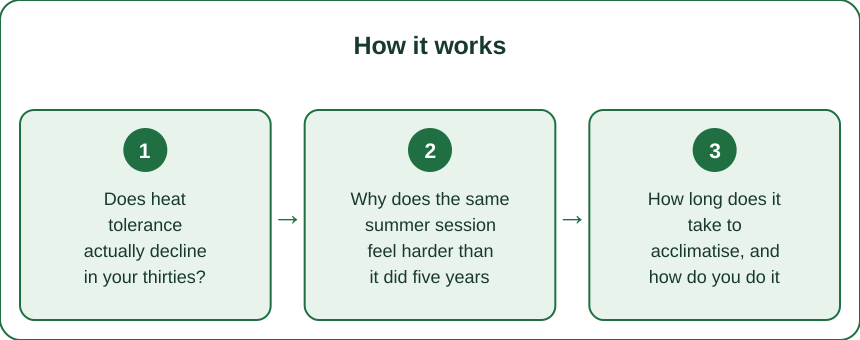
Does heat tolerance actually decline in your thirties?
Not meaningfully, and the evidence for a decade-based decline in healthy trained adults is weak.
Significant age-related changes in thermoregulation appear much later, typically from the sixties onward, and they involve reduced sweat gland output, slower skin blood flow responses, and blunted thirst.
In your thirties, none of that is happening yet. Sweat capacity, cardiovascular response to heat, and acclimatisation ability are all essentially intact.
What does change is everything around it:
Fitness level is the strongest predictor of heat tolerance, and it is far more predictive than age. A fit 38 year old tolerates heat better than an unfit 24 year old, comfortably.
Acclimatisation status matters enormously, and it is the thing most affected by lifestyle. Adaptation takes one to two weeks of repeated heat exposure and fades within a similar period. A life spent in air conditioning between a car and an office means arriving at each hot session unacclimatised.
Sleep quality affects heat tolerance directly, and sleep is where the thirties genuinely differ for many people. Poor sleep impairs thermoregulation and reduces exercise tolerance in heat.
Hydration status is often worse, not because of physiology but because of schedules — long meetings, childcare, and commutes are all environments where drinking regularly is inconvenient.
So the honest answer is: it is context, not decline. Which is good news, because context is modifiable.
Why does the same summer session feel harder than it did five years ago?
Because the inputs into the session changed more than the session did.
You are probably less acclimatised. Time spent outdoors in heat drops sharply with an indoor job and a car. Acclimatisation is use-it-or-lose-it, and a weekend-only outdoor exerciser never fully adapts.
You are starting more tired. Cumulative fatigue from work, caring responsibilities, and shorter sleep changes how a session feels far more than any physiological shift.
Your baseline activity is lower. Total daily movement typically falls through the late twenties and thirties, and the same workout sits on top of a less active base, which changes its relative demand.
Recovery time between sessions is shorter in practice. Not because recovery capacity has changed dramatically, but because the schedule allows less of it. Heat sessions specifically need more recovery, because they add thermal and fluid stress on top of mechanical stress.
Alcohol and caffeine patterns shift. Both affect fluid balance and sleep, and their effects are more noticeable when the margin is smaller.
And expectations are calibrated to your twenties. Comparing today’s session to a memory of a session done with more sleep, more base activity, and better acclimatisation is not a fair comparison.
What this points to: the fix is consistency of heat exposure, sleep, and hydration, rather than training harder or accepting decline.
How long does it take to acclimatise, and how do you do it deliberately?
Most of the adaptation happens in one to two weeks of consistent exposure, and it needs to be deliberate.
The timeline: the earliest changes — plasma volume expansion and reduced heart rate at a given workload — appear within days. Sweating adaptations, starting earlier and producing more dilute sweat, develop over one to two weeks.
The protocol: exercise in the heat for 60 to 90 minutes a day, at moderate intensity, for 7 to 14 consecutive days. Intensity does not need to be high. Consistency matters more than effort.
Practical versions for a normal life:
Move a regular easy session outdoors into the warmer part of the day, at reduced intensity, several times a week.
Do not do hard sessions in heat while adapting. The adaptation comes from exposure, not from suffering, and hard efforts in heat while unacclimatised is how people end up unwell.
Passive heat exposure contributes. A sauna or a hot bath after training produces some of the same adaptations, and it is a reasonable option when outdoor time is limited.
Expect the first three sessions to feel bad. That is the adaptation stimulus, not a warning sign, provided you are not showing heat illness symptoms.
It fades within one to two weeks away from heat, which is why a holiday or a busy fortnight indoors resets much of the progress.
Warning signs to stop: dizziness that does not resolve with rest, nausea, headache, confusion, unusual irritability, or stopping sweating. These are not part of the process and need cooling and medical attention.
What should recovery look like after a hot session in your thirties?
More deliberate than it needed to be at 25, and the differences are practical rather than dramatic.
Cool down actively, then cool down passively. Ten minutes of easy movement, then genuine cooling — a cool shower, cold water on the forearms and neck, shade and airflow. Staying hot for an hour after training compromises the whole evening, including sleep.
Rehydrate to a number, not to thirst. Weigh before and after, and replace roughly 125 to 150 percent of the loss over the following few hours. Thirst underestimates the deficit consistently, and it does so more when you are busy.
Include sodium in the rehydration if the session was long or hot. Plain water alone is excreted more readily.
Protect sleep, which is the actual recovery mechanism. An elevated core temperature delays sleep onset. Cooling properly in the evening is a sleep intervention as much as a recovery one.
Space hot hard sessions further apart. Two hard sessions in heat in consecutive days is a common cause of the flat, heavy feeling that gets attributed to age.
Eat properly afterwards. Appetite is suppressed by heat, and skipping the post-session meal is a frequent and avoidable recovery error in summer.
Watch the accumulation across a hot week. The problem is rarely one session. It is five sessions in a hot week with slightly inadequate recovery each time, which compounds into feeling wrecked by Friday.
What changes as the season turns, and what should you do about it?
The next few weeks are the best training window of the year, and it is easy to miss.
Cooling conditions plus full acclimatisation is the best combination available. You have spent a summer adapting, and the weather is about to ease. Performance in early autumn is often the best of the year for anyone who trained consistently through the heat.
Use it deliberately. This is the window to reintroduce the harder sessions that were compromised in August, to test progress, and to build a base before winter.
Expect acclimatisation to fade, and stop expecting yourself to handle the occasional late heatwave the way you did in mid-August.
Sleep improves as nights cool, and that alone lifts training quality noticeably within a week or two.
Do not increase volume and intensity at the same time. The temptation when everything suddenly feels easier is to add both. Add one.
Reassess the base. Late summer is a good moment to check that daily movement outside training has not quietly declined, since that base is what makes everything else sustainable.
Set up the winter plan now. The most common pattern is a strong summer followed by a collapse in November, and deciding in August what winter training will look like is what prevents it.
This is general guidance rather than medical advice. If heat intolerance is new, marked, or accompanied by symptoms like palpitations, unusual fatigue, or dizziness, that warrants a conversation with a doctor rather than a training adjustment.
FAQ: Heat and Training in Your Thirties, Answered
Is it normal to handle heat worse than I used to?
Common, and usually not physiological. Reduced acclimatisation, more air-conditioned time, less baseline activity, and less sleep explain most of it, and all of them are modifiable.
How long until I adapt to training in heat?
Most of the adaptation appears within 7 to 14 days of consistent exposure, at moderate intensity. It fades within a similar period once exposure stops.
Should I train hard in the heat to adapt faster?
No. Adaptation comes from repeated moderate exposure. Hard efforts while unacclimatised increase the risk of heat illness without speeding the process.
Why do I sleep badly after evening summer sessions?
An elevated core temperature delays sleep onset, and heat sessions keep it elevated longer. Cooling deliberately after training — a cool shower and cold water on the forearms — shortens that considerably.
TL;DR:
- Heat tolerance does not meaningfully decline in your thirties; acclimatisation, sleep, and baseline activity do the work.
- Deliberate heat acclimatisation takes 7 to 14 days of moderate exposure and fades just as fast.
- Recovery after hot sessions needs active cooling, measured rehydration with sodium, and protected sleep.
- Early autumn — full acclimatisation plus cooling weather — is the best training window of the year.
Move one easy session outdoors this week and keep it easy. That is the whole protocol.
Keep Reading
This article is for general informational purposes only and is not medical advice. Always consult a qualified health professional for guidance specific to you.