What Actually Changes About Training in Your Thirties: Answered Question by Question
Quick Answer: In your thirties, strength and muscle-building capacity barely change — the meaningful shifts are in recovery speed, tissue tolerance and life logistics. Training age matters more than chronological age. Adjust recovery, warm-up and progression rate, not the training itself, and most people can keep improving well into their forties.
The strength is still there.
The recovery between sessions is not what it was.
That is the actual change, and it is a scheduling problem more than a physiological one.

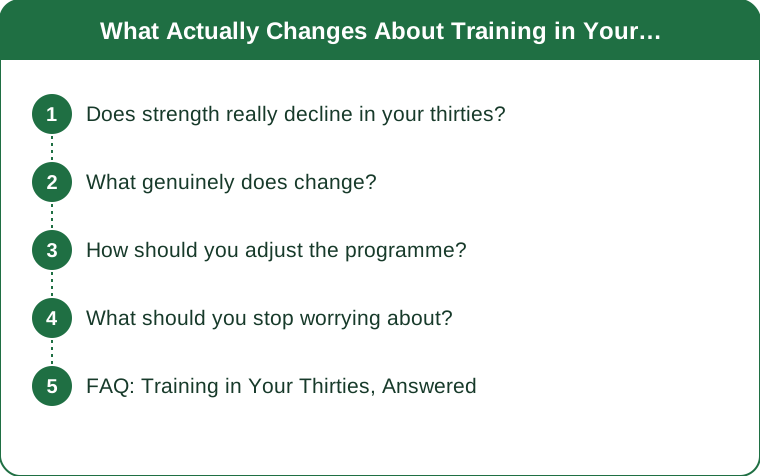
Does strength really decline in your thirties?
Not meaningfully, and this is the most misreported part of the whole topic.
Does muscle mass drop after 30?
The often-quoted figure of losing muscle from age 30 comes from studies of sedentary populations. In people who continue resistance training, the decline is very small until considerably later. Age-related loss is largely a training-status effect, not an inevitable clock.
Can I still build muscle in my thirties?
Yes, and at close to the same rate as in your twenties given the same training age. Training age — how long you have trained — predicts your rate of progress far better than chronological age. A 35-year-old beginner gains quickly; a 25-year-old with ten years of training gains slowly.
Does hormonal change matter yet?
For most people in their thirties, not much. Meaningful hormonal shifts arrive later, and their effect on trained individuals is smaller than the effect of sleep and consistency. If you have symptoms suggesting a hormonal issue, that is a conversation with a doctor rather than a training adjustment.
Should I train differently?
Mostly no. Progressive overload, compound movements, 2-4 sessions a week remains the right framework. What changes is how fast you add load and how much recovery you build in around it.
What genuinely does change?
Three things, and they are all recovery-side rather than performance-side.
How does recovery change?
This is the real difference. Time to full recovery between hard sessions lengthens somewhat, and the effect compounds with reduced sleep, higher stress and less free time. Most people in their thirties need one more rest day per hard training week than they did at 22 — not less training, differently spaced training.
Do tendons and connective tissue change?
Yes, and this is the most practically important shift. Tendon and ligament adaptation is slower than muscle adaptation at any age, and the gap widens with time. Muscle strength can outpace tendon tolerance, which is exactly how thirty-something athletes end up with tendinopathies. The fix is a slower rate of load progression — roughly 5-10 percent per week rather than large jumps — and consistent tendon-specific loading like slow heavy resistance work.
Does warm-up matter more?
Measurably. Tissue extensibility and joint lubrication take longer to reach working levels. Add 5-10 minutes to what you did in your twenties. Most thirties-onset niggles trace to warm-ups that were adequate ten years ago and are not now.
What about the life side?
This is bigger than the physiology for most people. Work, caring responsibilities and sleep disruption reduce both training time and recovery quality. Training plans that ignore this fail regardless of how well designed they are.

How should you adjust the programme?
Six practical changes, none of them dramatic.
How many hard sessions per week?
Most people do well with two to three genuinely hard sessions, with easier work around them. The common mistake is making every session hard, which worked at 22 on nine hours of sleep and does not now.
How fast should I add load?
5-10 percent per week at most, and less if anything is complaining. Tendons adapt more slowly than muscle, and this is the rate that keeps them together.
Should I still train heavy?
Yes. Heavy resistance training is one of the most protective things available for long-term bone density, muscle mass and metabolic health. Avoiding heavy work in your thirties is a worse bet than doing it well.
What about mobility?
Worth ten minutes most days rather than an hour occasionally. Consistency matters more than duration, and it is most valuable directly before training when it doubles as a warm-up.
How important is sleep now?
It becomes the limiting factor for most people. Seven to nine hours is the target, and chronic short sleep affects recovery, appetite regulation and injury risk simultaneously. If one thing is going to be fixed, this is it.
What about protein?
Requirements do not drop and arguably rise slightly. 1.6-2.2g per kilogram of bodyweight daily supports training adaptation, and most people under-consume it. This is general information, not medical advice — see a professional about persistent pain, or before starting a new programme with an existing condition.
Seasonal note: the shift into autumn is the single best training window of the year for most people — routines re-form, temperatures are comfortable, and there is a clear run to winter. Building the habit now, while daylight still supports it, means it survives December.
What should you stop worrying about?
Is my metabolism slowing down?
Much less than the folklore suggests. Research on total energy expenditure indicates it stays remarkably stable from roughly age 20 to 60 once body composition is accounted for. What usually changes is activity level and muscle mass, both of which are modifiable.
Am I too old to start something new?
No. Beginners in their thirties make rapid progress, and starting a new sport or lift now is genuinely reasonable. The main adjustment is progressing more gradually than an impatient beginner wants to.
Do I need to train around aches permanently?
Usually not. Most thirties-onset niggles come from insufficient warm-up, load progressed too fast, or a genuine imbalance — all of which are addressable. Persistent pain deserves assessment rather than acceptance.
Should I switch to lighter weights and higher reps?
Not as a rule. That advice is usually a proxy for wanting less joint stress, which is better achieved through better warm-up and slower progression than through abandoning heavy work.
Does gear matter more now?
Slightly, in the sense that comfort affects consistency. Kit that fits properly and does not need constant adjusting removes small frictions, and at this stage consistency is what everything depends on.
What is the single biggest predictor of how you train at 45?
What you do in your thirties. Consistency now compounds more than any programme detail, and the people training well at 45 are almost universally the ones who never stopped.
FAQ: Training in Your Thirties, Answered
Does strength really decline after 30?
Not meaningfully in people who keep training. The commonly cited decline comes from sedentary populations.
What actually changes?
Recovery speed and tendon tolerance, plus the life logistics around training. Not your capacity to build strength.
How much rest do I need?
Most people need about one more rest day per hard week than at 22, and two to three genuinely hard sessions rather than five.
How fast should I add weight?
5-10 percent per week at most. Tendons adapt more slowly than muscle, and that gap is what causes thirties-onset injuries.
How much longer should I warm up?
5-10 minutes more than you used to. It is the cheapest injury prevention available.
Is my metabolism slowing?
Far less than believed. Total energy expenditure is fairly stable from 20 to 60 once body composition is accounted for.
How much protein do I need?
1.6-2.2g per kilogram of bodyweight daily to support training adaptation. Most people fall short.
TL;DR:
- Strength and muscle-building capacity barely change in your thirties — training age matters more than age.
- The real shifts are recovery speed and tendon tolerance, not performance.
- Progress load at 5-10 percent per week, and add 5-10 minutes to your warm-up.
- Keep two to three genuinely hard sessions a week, and keep lifting heavy.
- Sleep 7-9 hours and eat 1.6-2.2g protein per kg — both become limiting factors.
This week, add one rest day and ten minutes of warm-up, and change nothing else. Most people feel the difference within a fortnight.
Keep Reading
This article is for general informational purposes only and is not medical advice. Always consult a qualified health professional for guidance specific to you.