What Actually Changes About Recovery in Your Thirties
Quick Answer: Peak strength and endurance change very little through your thirties. What changes measurably is recovery rate — sleep quality declines, tissue repair slows modestly, and life stress rises. The fix is managing recovery inputs rather than reducing training.
You can still hit the same numbers. The workout itself feels fine.
It is the Wednesday after Tuesday’s session that feels different than it did at 24 — and that is the whole story of training in your thirties.

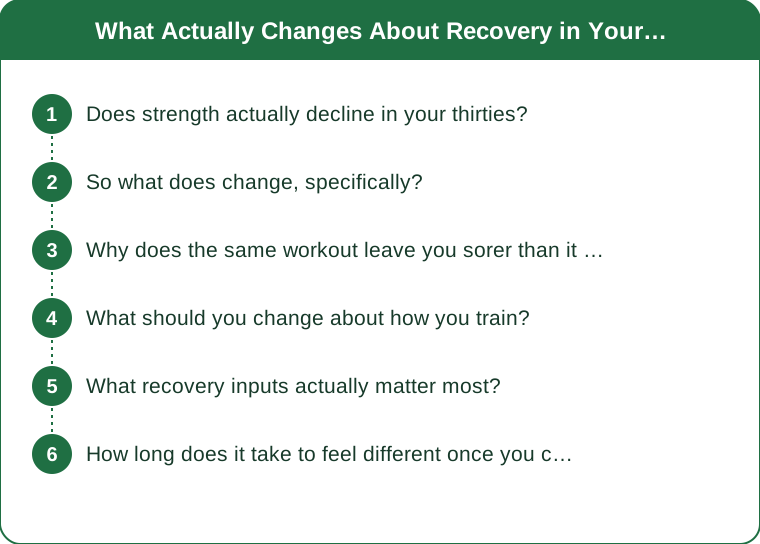
Does strength actually decline in your thirties?
Barely. Muscle mass and maximal strength typically remain near peak through the thirties and begin measurable decline in the forties, accelerating later — and even then, largely in people who stop training.
Cross-sectional data on trained populations consistently shows lifters setting personal bests well into their thirties and forties. Endurance athletes frequently peak in marathon and ultra distances in their mid-thirties, where accumulated aerobic base and pacing judgment outweigh any small physiological decline.
So if your lifts have stalled or your times have slipped, age is unlikely to be the cause at 32 or 36. Training consistency, sleep, and total stress load are far more probable explanations, and all three are addressable.
The honest summary: your ceiling has not moved much. Your rate of return to the ceiling has.
So what does change, specifically?
Three things, each modest on its own and meaningful in combination.
Sleep architecture shifts. Deep slow-wave sleep — the stage most associated with tissue repair and growth hormone release — declines gradually from the twenties onward. You may be sleeping the same number of hours with a different quality of those hours.
Muscle protein synthesis response blunts slightly. The anabolic response to a given dose of protein is a little less pronounced than at 22, which is why protein intake becomes a more useful lever now than it was then.
Life stress load rises sharply. This is usually the largest factor and the least physiological. Career demands, caregiving, financial pressure, and disrupted schedules all raise cortisol and reduce available recovery capacity. Your body does not distinguish between training stress and life stress; it has one budget.
Notice that only one of these three is genuinely about aging. Two are about circumstances — which is good news, because circumstances have levers.
Why does the same workout leave you sorer than it used to?
Partly perception, partly real, and partly a training-history artifact.
Delayed onset muscle soreness is driven mostly by unaccustomed eccentric load. In your twenties you likely trained more continuously, so fewer sessions were unaccustomed. In your thirties, training tends to be more interrupted — a busy month, a work trip, a sick kid — and each return produces a bigger soreness response.
There is a modest genuine change too. Inflammatory resolution slows slightly with age, so the clearance phase after a hard session takes somewhat longer.
And sleep debt amplifies everything. A single night of restricted sleep measurably increases perceived exertion and reduces performance the next day. Two or three in a row and a familiar session genuinely feels harder.
The practical read: soreness that shows up after inconsistent training is a consistency signal, not an age signal.

What should you change about how you train?
Less than most people assume, and in a different direction than they expect.
Do not reduce intensity. Heavy loading is what preserves muscle and bone, and it is more valuable now, not less. Keep working sets in ranges that are genuinely hard.
Do adjust frequency and distribution. Instead of three brutal sessions, four moderate ones spread the same total work with better recovery between. Same weekly volume, lower per-session damage.
Extend warm-ups. 10 to 12 minutes rather than 4. This is the change nearly every experienced lifter over thirty converges on independently, and it is about tissue readiness rather than injury superstition.
Deload deliberately. Every 5 to 8 weeks, take a week at roughly 60 percent volume. In your twenties you could ignore this and get away with it. Now it is the difference between a productive year and a year of small setbacks.
Track a readiness signal. Resting heart rate on waking, or a simple 1-to-5 subjective score. When it is off for two consecutive days, do the moderate session instead of the hard one.
What recovery inputs actually matter most?
Ranked honestly by effect size, because the popular ones are not the strongest ones.
Sleep, by a wide margin. Seven to nine hours, consistent timing. If you fix one thing, fix this. A consistent bedtime matters nearly as much as duration, because sleep architecture responds to regularity.
Protein intake. Roughly 1.6 to 2.2 g per kg of bodyweight daily, distributed across 3 to 4 meals of 25 to 40 g each. Distribution matters more now than it did at 22 because of the blunted per-dose response.
Total calorie adequacy. Chronic under-eating while training hard is the most common recovery failure in this age group, especially among women. Recovery is expensive; underfunding it produces exactly the symptoms people attribute to age.
Stress management. Not a wellness platitude — a physiological input. Whatever reliably lowers your baseline arousal, whether that is a walk, breathing practice, or protecting one evening a week, buys real recovery capacity.
Everything else — cold plunges, compression, massage guns, supplements — ranges from mildly helpful to neutral. They are worth doing if you enjoy them and have the first four handled. They do not substitute for any of them.
This is general information, not medical advice. Persistent fatigue, unexplained performance decline, or symptoms beyond normal training tiredness are worth discussing with a clinician — thyroid function and iron status are both worth checking.
How long does it take to feel different once you change things?
Faster than most people expect, which is the encouraging part.
Sleep consistency: noticeable within 5 to 7 nights of a regular schedule. This is the fastest-acting lever available.
Protein distribution: 2 to 3 weeks to notice reduced soreness and better session-to-session readiness.
Deload structure: the effect shows up in the week after the deload, typically as a session that feels unusually easy at a familiar weight.
Warm-up extension: immediate. The first session with a proper 12-minute warm-up usually feels different in the first working set.
Give any combination of these 6 weeks before drawing conclusions. Most people who believe their thirties ended their training discover within a month and a half that what actually ended was their sleep schedule.
TL;DR:
- Peak strength and endurance hold well through the thirties; recovery rate is what shifts.
- The three real changes are sleep architecture, a slightly blunted protein response, and a much higher life stress load.
- Keep intensity, spread volume across more moderate sessions, extend warm-ups, and deload every 5–8 weeks.
- Sleep, protein, adequate calories, and stress management dominate every recovery gadget available.
The workout was never the problem. The 48 hours around it were — and unlike your age, those are entirely negotiable.
Keep Reading
This article is for general informational purposes only and is not medical advice. Always consult a qualified health professional for guidance specific to you.