Do You Actually Need to Warm Up Longer in Your Thirties Than You Did in Your Twenties?
Quick Answer: Yes — tissue elasticity and joint lubrication (synovial fluid production) both decline gradually starting in your 30s, meaning muscles and connective tissue take measurably longer to reach optimal working temperature, so a 5-10 minute dynamic warm-up that felt optional at 25 becomes genuinely protective by your mid-to-late 30s.
You used to walk into the gym, do a couple of arm circles, and go straight into your working sets. Now the same abbreviated warm-up leaves you feeling stiff and unprepared through the first several reps — and that’s not just in your head.

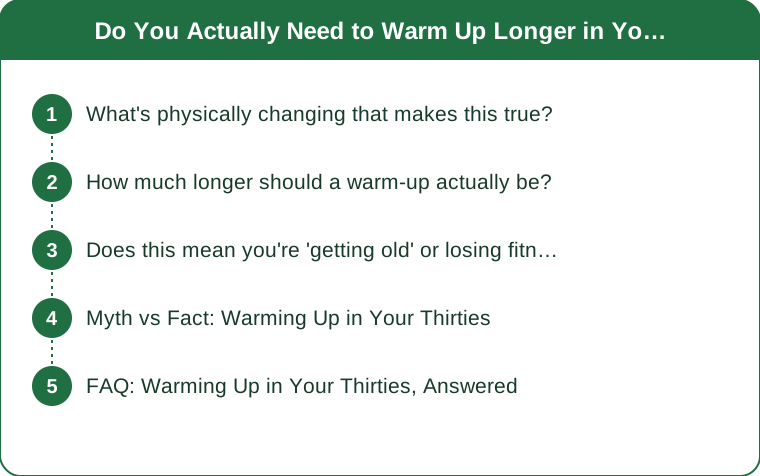
What’s physically changing that makes this true?
Synovial fluid production (the natural lubricant in your joints) and tissue elasticity in tendons and muscles both gradually decline starting in your 30s. This doesn’t mean sudden fragility — it means the tissue takes measurably more time and gradual movement to reach the temperature and pliability where it performs and protects optimally.
How much longer should a warm-up actually be?
Most sports science guidance suggests moving from a 3-5 minute warm-up in your 20s to a 5-10 minute dynamic warm-up by your mid-30s, especially before higher-intensity or heavy-load activity. The exact number matters less than the principle: gradually increasing movement complexity and range before working sets, rather than jumping straight to full intensity.

Does this mean you’re ‘getting old’ or losing fitness?
No — this is a normal physiological timeline that happens regardless of fitness level, and highly trained athletes in their 30s and 40s follow the same warm-up principle, not because they’re less capable, but because it’s simply more protective and performance-enhancing at this stage of tissue physiology.
Myth vs Fact: Warming Up in Your Thirties
Myth: Needing a longer warm-up means you’re less fit than you used to be. Fact: it’s an independent physiological factor related to tissue elasticity, separate from your actual fitness level or strength.
Myth: Static stretching before a workout is the best way to warm up. Fact: dynamic movement (leg swings, bodyweight squats, light cardio) that gradually raises temperature and mobilizes joints is generally more effective pre-workout than static holds.
Myth: A longer warm-up means a shorter effective workout. Fact: an adequate warm-up typically improves output during the working portion of a session enough to offset the extra time spent.
FAQ: Warming Up in Your Thirties, Answered
Does this apply to cardio workouts the same as strength training?
Yes, though the specific warm-up content differs — cardio benefits from a gradual intensity ramp, while strength training benefits more from joint mobility plus a lighter warm-up set of the actual movement.
Is 5-10 minutes enough for high-intensity activities like sprinting?
Often a bit more is warranted for genuinely high-intensity, high-impact activity — some guidance suggests up to 10-15 minutes for sprint or heavy plyometric work specifically.
Should warm-up length keep increasing further into your 40s and beyond?
Generally yes, gradually — the same tissue elasticity and joint lubrication trend continues, though individual variation based on training consistency is significant.
TL;DR:
- Synovial fluid and tissue elasticity both gradually decline starting in your 30s, which is real, measurable physiology
- A 5-10 minute dynamic warm-up is generally more appropriate than the shorter warm-ups that worked in your 20s
- This isn’t a sign of declining fitness — even elite athletes in their 30s and 40s follow the same principle
- Dynamic movement generally outperforms static stretching as a pre-workout warm-up
Your instinct to jump straight in was fine at 25 — in your 30s, the extra five minutes is protecting the exact strength you’re trying to build.
Keep Reading
This article is for general informational purposes only and is not medical advice. Always consult a qualified health professional for guidance specific to you.