Zone 2 Cardio in Your Thirties: The Questions Everyone Asks
Quick Answer: Zone 2 is easy aerobic work where you can hold a conversation — roughly 60 to 70% of maximum heart rate for most people. In your thirties it is worth doing mainly because it builds aerobic capacity with low recovery cost, which is exactly the trade-off that matters when time and recovery are the constraints. Two to three sessions a week of 30 to 45 minutes is a realistic and effective dose.
Every podcast recommends it. Nobody says how slow is slow, how much is enough, or whether it works if you only have three hours a week.

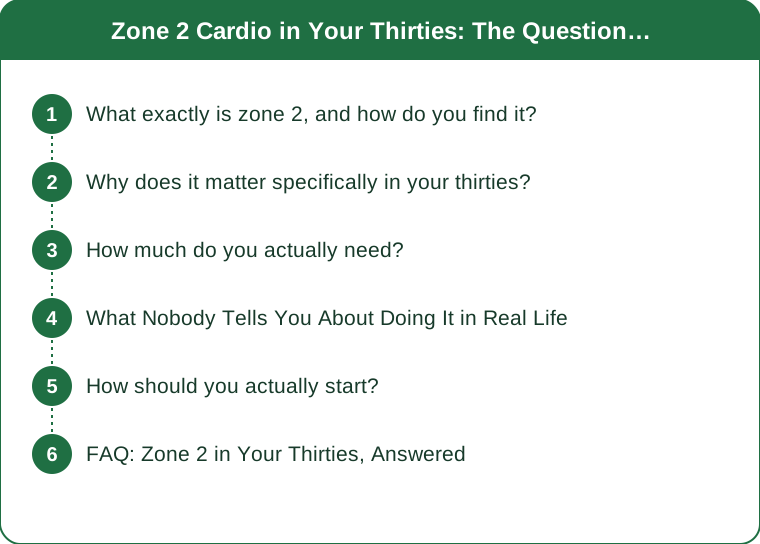
What exactly is zone 2, and how do you find it?
Zone 2 is the intensity at which your body is producing energy almost entirely aerobically, with lactate staying low and stable. In practice that is easy, conversational, sustainable effort.
The most reliable field test is the talk test. You should be able to speak in full sentences and would rather not. If you can sing, you are too easy. If you are speaking in three-word bursts, you are above zone 2.
By heart rate, the common estimate is 60 to 70% of your maximum. Maximum is roughly 220 minus your age as a very rough starting point — for a 35-year-old that is around 185, putting zone 2 somewhere around 111 to 130 beats per minute. Treat that as a starting hypothesis, not a fact, because individual maximum heart rate varies a great deal from the formula.
By breathing, which is the most practical marker: nasal breathing only. If you can breathe through your nose for the whole session, you are almost certainly in or below zone 2. The moment you need your mouth, you have gone above it.
By perceived effort: 3 or 4 out of 10. It should feel like something you could do for two hours.
And the most common finding when people first measure it: it is much slower than they expected. Most people’s habitual easy pace is actually zone 3 — too hard to build aerobic base efficiently and too easy to be a real interval session. Correcting that is most of the benefit.
Why does it matter specifically in your thirties?
Because the binding constraint shifts from motivation to recovery and time, and zone 2 is the training that respects both.
Recovery capacity is the honest variable. Recovery slows more noticeably than strength or fitness does through the thirties, particularly if sleep is compromised by work or small children. A high-intensity session costs real recovery days. A zone 2 session costs almost none, which means you can accumulate meaningful volume without accumulating fatigue.
Aerobic capacity is a strong marker worth maintaining. Cardiorespiratory fitness is among the more robust predictors used in long-term health research, and the thirties are when a lot of people’s aerobic fitness quietly declines because life got busy. Zone 2 is the most efficient way to build and hold it per unit of fatigue.
It stacks with strength training rather than competing. This is the practical argument. Hard cardio and hard lifting in the same week interfere with each other — the so-called interference effect — and easy aerobic work interferes far less. If you lift twice a week and want to add cardio, zone 2 is the version that does not cost you your lifting.
And it is sustainable with a schedule. You can do it tired, early, after a poor night’s sleep, or with a stroller. High-intensity work done in that state is either ineffective or unwise; easy aerobic work is fine. For most people in their thirties, that flexibility is what makes it happen at all.
What it is not: a fat-loss protocol. The old fat-burning-zone framing is a misreading — total energy expenditure and diet drive body composition, not the fuel mix at a given intensity.
How much do you actually need?
Less than the podcasts imply, and consistency matters more than volume.
The frequently quoted target is 3 to 4 hours a week, drawn from endurance-athlete practice. That is not the requirement for general fitness in a busy life.
A realistic and genuinely effective dose: two to three sessions of 30 to 45 minutes a week. That is 90 minutes to just over two hours, and it produces meaningful aerobic adaptation in most previously undertrained people within 8 to 12 weeks.
Sessions shorter than about 20 minutes still count, and they are less efficient because the adaptation is driven substantially by time at intensity. If 20 minutes is what you have, do 20 minutes.
How it fits with everything else, for a typical week:
- Two strength sessions — the priority for most people in their thirties.
- Two zone 2 sessions of 30 to 45 minutes.
- Optionally one short harder session — intervals or a hard finish — once you have a base.
- Daily walking, which genuinely counts toward the same system.
The single biggest mistake in dosing: doing all your cardio at a moderate-hard intensity because it feels more productive. That is the middle ground that produces fatigue without either the aerobic base or the high-intensity stimulus. Easy should be genuinely easy and hard should be genuinely hard.
And walking is legitimate. A brisk walk, especially with a hill or a weighted pack, puts many people squarely in zone 2 — and for anyone starting from a low base, it is the most accessible entry point there is.

What Nobody Tells You About Doing It in Real Life
Your easy pace will feel embarrassingly slow at first, and it improves quickly. Most people find their zone 2 running pace is a slow jog or even a fast walk initially, which is discouraging. It also improves faster than almost any other metric — the same heart rate at a noticeably faster pace within 8 to 12 weeks is the standard experience.
Wrist heart-rate monitors are unreliable at the boundaries. Optical wrist sensors are prone to error, particularly in cold weather, during arm movement, and at lower intensities. A chest strap is substantially more accurate and it costs relatively little. If your data looks erratic, suspect the device before your body.
Heart rate drifts upward over a long session at the same effort. Cardiac drift is normal — 30 minutes into an easy session your heart rate may be 5 to 10 beats higher at the same pace, due to heat and dehydration. Chasing the number down by slowing further is usually unnecessary; hold the effort.
Hills wreck the intensity control. On any rolling route you will exceed zone 2 on the climbs regardless of effort management. Flat routes, a treadmill, a bike, or simply walking the hills are the practical answers, and this is why so many people find cycling easier to keep in zone.
Cycling and the elliptical are easier to hold in zone than running. Running has a minimum intensity below which the mechanics get awkward, and for many people that minimum is above zone 2. If your easy run keeps drifting up, a bike solves it immediately.
And heat, sleep, illness, and caffeine all move your heart rate at a given effort. A hot day, a bad night, or a strong coffee raises it by several beats. Go by effort and breathing on those days rather than by the number.
How should you actually start?
Four weeks of establishing the intensity, then build. Keep it simple.
Weeks 1 to 4: find and hold the intensity.
- Pick a mode you can control — cycling, treadmill, flat route, or brisk walking. Not a hilly run.
- Two sessions a week, 25 to 30 minutes.
- Use nasal breathing as the governor. If you have to open your mouth, slow down. No device required.
- Accept that it is slow. Do not compare to what you used to do.
Weeks 5 to 12: build the duration.
- Extend to 40 to 45 minutes on one or both sessions.
- Add a third session if the schedule allows and you are recovering well.
- Keep the intensity honest — the temptation to creep up as fitness improves is the main way this stops working.
After 12 weeks: add one shorter harder session a week if you want, and keep the easy work easy. The polarised pattern — mostly easy, a little hard, almost nothing in the middle — is what the endurance literature broadly supports.
Track one number. Your pace or power at a fixed heart rate, checked every few weeks. Improvement shows up there long before it shows up anywhere else, and it is the metric that tells you the training is working.
Two practical notes. A chest strap is worth the modest cost if you intend to train by heart rate at all. And do it in a way that survives a bad week — the sessions you can do tired, cold, or short on time are the ones that accumulate.
Seasonal note: cooler autumn weather makes zone 2 substantially easier to hold than summer heat, because heart rate at a given pace drops noticeably as temperatures fall — many people find their pace at the same heart rate improves in September and October and mistake it for fitness. Some of it is, and some is the weather. Enjoy both. If you have any cardiac history, chest symptoms, or have not exercised in a long time, check with your doctor before starting a new programme. This is general information, not medical advice.
FAQ: Zone 2 in Your Thirties, Answered
Do I need a heart rate monitor to do zone 2 properly?
No. Nasal breathing and the talk test are reliable and free — if you can breathe through your nose and speak in full sentences, you are in the right place. A chest strap is useful if you want to track progress at a fixed heart rate over months, and a wrist optical sensor is often inaccurate enough at low intensities to be misleading.
Is walking enough, or do I have to run?
For many people, particularly those starting from a lower base or carrying more weight, a brisk walk sits comfortably in zone 2 — and if it does, it is doing the job. Adding a hill or a weighted pack raises it further. Running is not required, and for people whose easy run keeps drifting too hard, cycling or walking is the more effective choice.
Can I do zone 2 and strength training in the same week?
Yes, and that combination is the practical answer for most people in their thirties. Easy aerobic work interferes much less with strength adaptation than high-intensity cardio does, which is a large part of why it is recommended. Two lifting sessions plus two zone 2 sessions is a well-balanced week that fits into limited time and does not overrun your recovery.
TL;DR:
- Zone 2 is conversational effort, roughly 60 to 70% of max heart rate — nasal breathing is the simplest reliable governor
- It matters in your thirties because it builds aerobic capacity at almost no recovery cost, which is the real constraint
- Two to three sessions of 30 to 45 minutes a week is a realistic and genuinely effective dose
- It will feel slower than expected at first and improves fast; track pace at a fixed heart rate to see it
- Use flat routes, a bike, or brisk walking to hold the intensity, and keep easy easy so hard can be hard
The recommendation is right and the framing is usually wrong. This is not four hours a week of athlete training — it is two easy sessions that fit around lifting and a full life, done slowly enough to actually be easy.
Keep Reading
This article is for general informational purposes only and is not medical advice. Always consult a qualified health professional for guidance specific to you.