Why Your Thirties Workout Recovery Depends More on Sleep Timing Than Total Hours
Quick Answer: Recovery in your thirties depends heavily on sleep consistency and timing, not just total hours — growth hormone release is concentrated in the first sleep cycles, so a late, irregular bedtime can blunt recovery even at 7-8 total hours. Anchoring a consistent sleep window matters more now than it did a decade ago.
You’re sleeping roughly the same number of hours you always have, but the soreness from Tuesday’s workout is still there Thursday morning. The math of ‘hours slept’ hasn’t changed — something about the timing has.

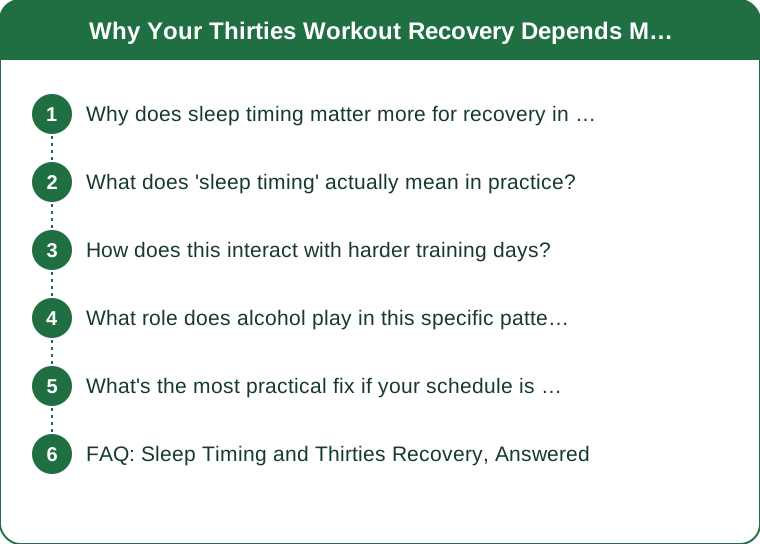
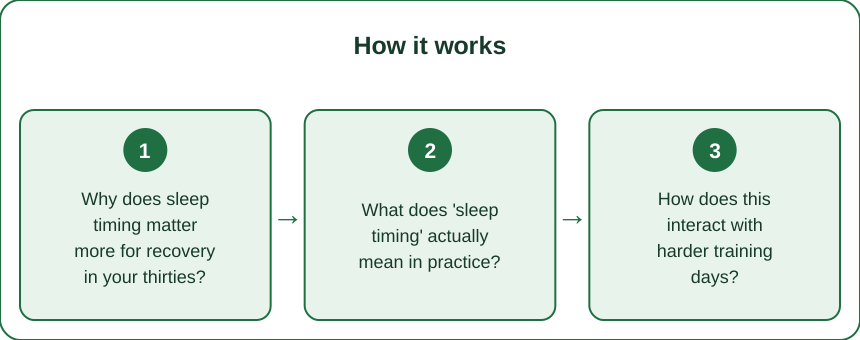
Why does sleep timing matter more for recovery in your thirties?
Growth hormone release, which drives much of muscle repair, is concentrated in the first few sleep cycles of the night — roughly the first 3-4 hours. Going to bed at inconsistent times, or later than your body’s natural window, means those crucial early cycles happen at a lower-quality point in your sleep architecture, even if total hours stay the same.
In your twenties, a more resilient recovery system could partly compensate for this variability. By your thirties, that buffer is thinner, which is why the same ‘enough hours’ now produces slower visible recovery.
What does ‘sleep timing’ actually mean in practice?
It means going to bed and waking up within roughly the same 30-60 minute window most nights, rather than anchoring only to total hours. A week of 7 hours at consistent times often produces better recovery than a week of 7.5 hours at wildly different bedtimes.
Does a consistent wake time matter as much as bedtime?
Yes — arguably more. A stable wake time anchors your circadian rhythm even when bedtime shifts slightly, which is why sleep experts often recommend fixing wake time first if you can only control one variable.
How does this interact with harder training days?
On days with more intense strength or conditioning work, the recovery cost of inconsistent sleep timing compounds — a hard session followed by a late, irregular night tends to produce noticeably more next-day soreness than the same session followed by a consistent-timed night, even at equal total hours.
This is part of why some people in their thirties start deliberately protecting sleep timing around harder training days specifically, rather than treating every night the same.

What role does alcohol play in this specific pattern?
Alcohol fragments the early sleep cycles that growth hormone release depends on, even when total time asleep looks normal on a tracker. A glass of wine that felt harmless in your twenties can measurably blunt recovery quality in your thirties when combined with an already tighter recovery margin.
Is it the alcohol itself or the timing of drinking that matters more?
Both — but drinking closer to bedtime has a more pronounced effect on those early-cycle disruptions than the same amount consumed several hours earlier in the evening.
What’s the most practical fix if your schedule is genuinely inconsistent?
Anchor wake time first, even on inconsistent nights. If bedtime has to shift due to work or family schedules, holding wake time steady limits how much circadian disruption accumulates.
Where possible, protect sleep timing specifically the night after a hard training session — this is the single highest-leverage night to keep consistent, even if other nights that week are more flexible.
FAQ: Sleep Timing and Thirties Recovery, Answered
Does this mean total sleep hours don’t matter at all?
No — total hours still matter, but timing consistency is the variable most people in their thirties overlook while still hitting a reasonable total.
How long does it take to notice a difference from more consistent sleep timing?
Many people notice a difference in next-day soreness and energy within 1-2 weeks of a more consistent schedule.
Is this pattern different for men and women in their thirties?
Hormonal recovery windows differ somewhat, but the core mechanism — early sleep cycles driving repair — applies broadly across both.
TL;DR:
- Growth hormone release concentrates in early sleep cycles, making timing matter as much as total hours
- A consistent 30-60 minute sleep window often beats more total hours at inconsistent times
- Alcohol disrupts exactly the early cycles recovery depends on, more so than in your twenties
- Anchor wake time first, and protect sleep timing especially the night after hard training
The hours were never the whole story — consistency is the lever that changes recovery the most in your thirties.
Keep Reading
This article is for general informational purposes only and is not medical advice. Always consult a qualified health professional for guidance specific to you.