Why Workout Recovery Suddenly Takes Longer in Your Thirties
Quick Answer: Recovery slows in your thirties primarily due to gradually declining growth hormone and collagen production plus accumulated life stress competing for the same recovery resources — not because you’re suddenly ‘old,’ and the fix is adjusting training volume and prioritizing sleep, not stopping intense training altogether.
You did the exact same workout you’ve done for years, and this time you’re still sore on day three. Nothing about the workout changed — your recovery biology quietly did.

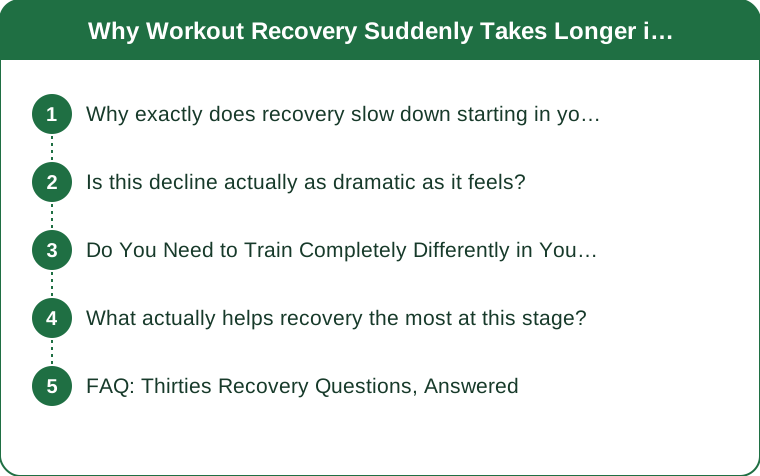
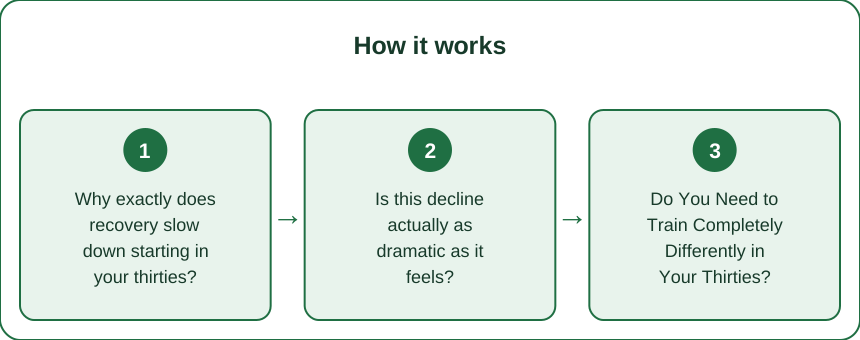
Why exactly does recovery slow down starting in your thirties?
Growth hormone production, which peaks in your twenties, begins a gradual natural decline through your thirties, and this hormone plays a direct role in tissue repair — combined with slowly decreasing collagen synthesis, muscle and connective tissue simply take longer to rebuild than they did a decade earlier.
Is this decline actually as dramatic as it feels?
Not usually — the biological decline itself is gradual, but it often collides with rising life stress (career demands, parenting, less sleep) in your thirties, and cortisol from chronic stress directly competes with recovery processes, making the felt difference feel much bigger than the hormone decline alone would explain.

Do You Need to Train Completely Differently in Your Thirties?
Not completely — but volume and recovery spacing matter more than they used to. The same weekly training load that worked at 25 may need an extra rest day, or slightly reduced volume per session, to actually be absorbed and adapted to rather than just accumulated as fatigue.
What actually helps recovery the most at this stage?
Sleep quality and quantity is the single biggest lever — more than any supplement or recovery gadget, consistent 7-9 hour sleep directly supports the growth hormone release that naturally happens during deep sleep, partially offsetting the age-related decline.
FAQ: Thirties Recovery Questions, Answered
Should I stop high-intensity training in my thirties?
No — high intensity training remains valuable and even helps maintain the hormone production that supports recovery; the key is adjusting frequency and rest, not intensity itself.
Do supplements actually help recovery at this age?
Basics like adequate protein intake and staying hydrated matter more than specialty supplements — there’s no substitute for sleep and appropriate training load management.
At what point should slower recovery be checked by a doctor?
If soreness or fatigue feels disproportionate to your training, or recovery time is dramatically worsening month over month, it’s worth ruling out issues like thyroid function or overtraining syndrome.
TL;DR:
- Growth hormone and collagen production gradually decline through your thirties
- Rising life stress often amplifies the felt difference more than biology alone
- Training volume and rest spacing need small adjustments, not a full stop
- Sleep is the single biggest recovery lever at this life stage Slower recovery isn’t decline — it’s your body asking for smarter spacing, not less effort.
Keep Reading
This article is for general informational purposes only and is not medical advice. Always consult a qualified health professional for guidance specific to you.