Why Does Everything Take Longer to Heal in Your Thirties Than It Used To?
Quick Answer: Recovery genuinely does slow down through the thirties due to gradual declines in collagen production, blood flow efficiency, and cellular repair rate — the change is real and measurable, not just a perception shift, though good sleep, adequate protein, and appropriately paced rehab still meaningfully speed healing at any age.
It’s a common, slightly unsettling realization in the thirties: an injury that would have resolved in days a decade earlier now drags on for weeks. Below are the actual physiological reasons why, broken down question by question.

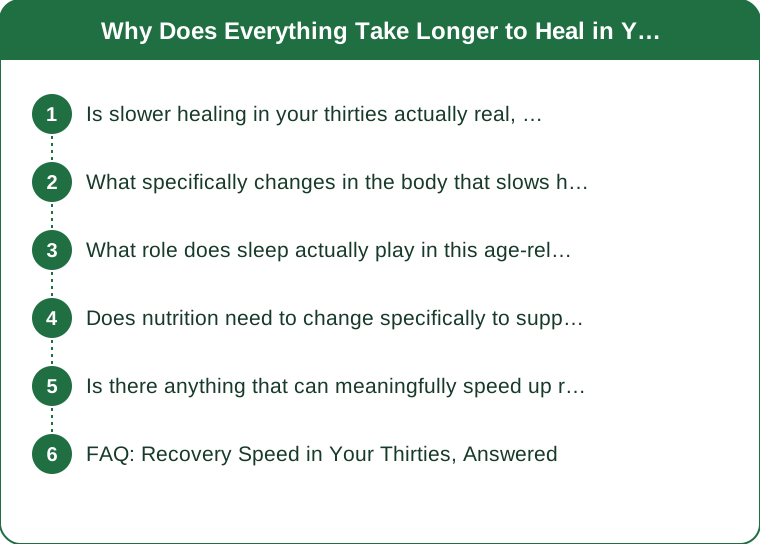
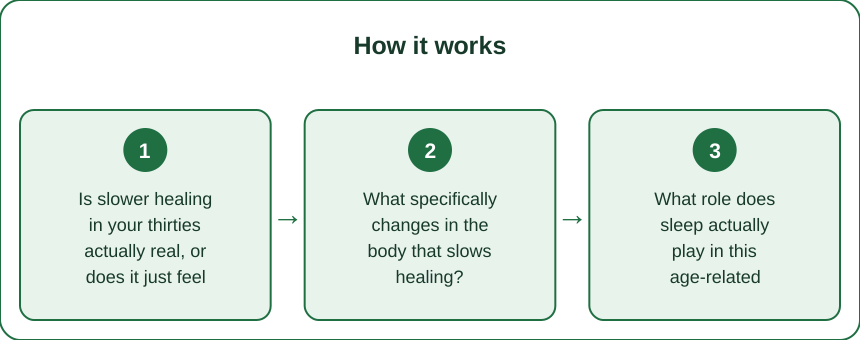
Is slower healing in your thirties actually real, or does it just feel that way because you’re busier and notice it more?
It’s genuinely real, not just perception. Multiple physiological changes — reduced collagen synthesis, slightly reduced blood flow efficiency to tissues, and a gradual decline in certain cellular repair processes — begin measurably in the late twenties and continue through the thirties and beyond. That said, busier schedules and less built-in recovery time (compared to, say, college-age free time) can compound the perception on top of the real physiological shift.
What specifically changes in the body that slows healing?
Collagen production, which is essential for repairing skin, tendons, ligaments, and connective tissue, gradually declines starting in the mid-to-late twenties, continuing steadily through the thirties. This directly affects how quickly soft tissue injuries (sprains, strains) repair, since collagen synthesis is a core part of that repair process.
Circulation efficiency also shifts gradually with age, and since blood flow delivers the oxygen and nutrients tissue needs to repair itself, even modest reductions in circulation efficiency can measurably slow healing time for any given injury.
Does this mean fitness level doesn’t matter anymore for recovery speed?
Fitness level still matters enormously — arguably more than in your twenties, not less. Well-conditioned, active thirty-somethings generally recover faster than sedentary ones at the same age, since good baseline circulation, muscle tone, and overall metabolic health all support tissue repair. The age-related slowdown is a real headwind, but it’s not the only factor, and it’s one that consistent fitness habits can partially offset.
What role does sleep actually play in this age-related recovery shift?
A larger role than most people assume, and one that becomes more important with age, not less. Deep sleep is when the majority of tissue repair and growth hormone release occurs, and sleep quality (not just quantity) has been shown to decline somewhat for many people through their thirties, compounding the age-related healing slowdown with a sleep-related one on top of it. Prioritizing consistent, quality sleep during a recovery period is one of the highest-leverage, most controllable factors available.

Does nutrition need to change specifically to support recovery in your thirties?
Protein intake becomes more directly important for injury recovery specifically, since adequate protein provides the building blocks collagen synthesis and muscle repair both require, and the body’s protein synthesis efficiency also gradually declines with age, meaning intake needs may need to rise somewhat to achieve the same repair rate as a decade earlier. This is general information, not medical advice — specific protein needs vary by individual and injury type, and a healthcare provider or dietitian can give more tailored guidance for a specific situation.
Should thirty-somethings expect this slowdown to keep getting worse every year?
The rate of change through the thirties specifically is generally gradual, not dramatic — the shifts described here are measurable over years, not something that changes noticeably month to month. Maintaining good habits through this decade meaningfully supports recovery capacity well into the following decades, not just the thirties in isolation.
Is there anything that can meaningfully speed up recovery despite this age-related slowdown?
Yes, several factors are genuinely within individual control. Consistent, quality sleep, adequate protein intake, staying appropriately active during recovery (rather than complete rest, which research increasingly shows can slow tissue repair for many injury types when overdone), and avoiding rushing back to full intensity too early (which risks re-injury and resets the recovery clock) all measurably help. Working with a physical therapist for anything beyond a minor injury can also meaningfully improve both recovery speed and quality of the healed tissue, since a paced, appropriate rehab plan outperforms either complete rest or an overly aggressive return to activity.
FAQ: Recovery Speed in Your Thirties, Answered
Does this slowdown affect men and women differently?
Both experience gradual collagen and circulation changes through this decade, though the exact timeline and hormonal contributors differ somewhat between sexes — this is general information, not medical advice.
Is it worth taking collagen supplements specifically to offset this?
Some people find them helpful, though evidence is still developing — adequate overall protein intake is the better-established foundation regardless of whether a specific collagen supplement is added on top.
At what point should slow-healing be checked by a professional instead of assumed to be normal aging?
An injury that isn’t improving at all after a couple of weeks, or that worsens rather than gradually improves, is worth having evaluated rather than attributed to normal age-related slowdown.
TL;DR:
- Slower healing in your thirties is a real, measurable physiological shift, not just a perception change
- Declining collagen production and circulation efficiency are the two biggest underlying factors
- Fitness level, sleep quality, and protein intake all meaningfully influence recovery speed at any age
- Appropriately paced rehab, rather than complete rest or rushing back too soon, produces the best outcomes
A longer recovery timeline in your thirties isn’t a sign anything is wrong — it’s a normal physiological shift, and it responds well to the same controllable habits that support health at any age.
Keep Reading
This article is for general informational purposes only and is not medical advice. Always consult a qualified health professional for guidance specific to you.