What Actually Changes About Fitness in Your Thirties (And What Doesn't)
Quick Answer: Metabolism itself barely changes in your thirties — the real shifts are slower recovery between hard sessions and a gradual decline in muscle mass if strength training isn’t part of your routine. Both are manageable with small adjustments, not a total overhaul.
Does metabolism really slow down at 30?
Research tracking metabolic rate across adulthood shows it stays essentially stable from your 20s through your 50s — the common ’30s metabolism crash’ claim doesn’t hold up under actual measurement. What often changes instead is activity level and muscle mass, both of which affect calorie burn independently of age itself.
Why does recovery feel slower even if metabolism hasn’t changed?
Recovery capacity does show measurable decline starting in the early-to-mid thirties, related to changes in growth hormone production and connective tissue resilience. A workout that left you fully recovered in 24 hours at 25 might genuinely need 36-48 hours at 33 — this is real and worth planning around, unlike the metabolism myth.
Does muscle mass actually decline in your thirties?
Without strength training, adults typically lose 3-5% of muscle mass per decade starting around age 30, a process called sarcopenia that accelerates further after 40. This decline is largely preventable with consistent resistance training, which is one of the few interventions shown to meaningfully offset it.
Is it harder to lose weight in your thirties than your twenties?
Weight management difficulty in your thirties is more often explained by lifestyle changes — less incidental movement from a settled career, more sedentary time, changed eating patterns — than by any inherent metabolic shift. Controlling for activity level, weight loss mechanics remain largely the same.
What should actually change about your workout routine?
Prioritizing 2-3 strength sessions weekly becomes more important than in your twenties, specifically to counter the natural muscle loss trend. Building in an extra recovery day between high-intensity sessions, and taking warm-ups more seriously, both address the real recovery-speed change without needing to reduce overall training volume.

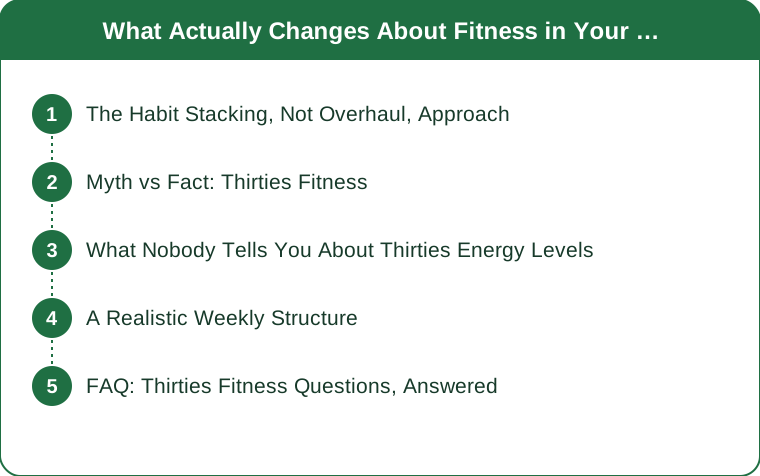
The Habit Stacking, Not Overhaul, Approach
The biggest practical shift that actually helps in your thirties isn’t a dramatically different program — it’s building fitness into existing routines rather than treating it as a separate block of time to protect. Walking meetings, strength training during a lunch break, or a short session before family obligations start tend to stick better than an idealized 90-minute gym block that competes with a busier schedule.
Myth vs Fact: Thirties Fitness
Myth: You need to train completely differently once you turn 30. Fact: the core principles of progressive overload, adequate protein, and consistent training still apply exactly as they did in your twenties. Myth: Injuries become inevitable in your thirties. Fact: injury risk relates far more to training load management and recovery than to age itself — well-managed programs remain low-risk.

What Nobody Tells You About Thirties Energy Levels
Reported energy dips in the thirties often trace back to sleep quality and stress load changes (career demands, caregiving responsibilities) rather than any physiological aging process specific to fitness capacity. Addressing sleep consistency frequently does more for perceived energy than any workout change.
A Realistic Weekly Structure
2-3 strength sessions of 30-45 minutes, 1-2 cardio sessions matched to your actual schedule availability, and at least one full rest day with active recovery (walking, light stretching) built in deliberately rather than happening by accident when you run out of time.
FAQ: Thirties Fitness Questions, Answered
Do I need to eat differently in my thirties for fitness goals?
Protein needs don’t change dramatically, but prioritizing it becomes more valuable given the muscle-preservation goal — aim for roughly 0.7-1g per pound of body weight if strength training regularly.
Is it too late to start strength training in your thirties?
Not remotely — most muscle and strength gains studied in strength training research apply just as strongly to people starting in their 30s, 40s, and beyond as to younger lifters.
How much does hormonal change actually affect thirties fitness?
For most people, hormonal shifts in the thirties are gradual and modest compared to perimenopause-related changes later — training and recovery habits explain far more of the difference than hormones alone.
TL;DR:
- Metabolism itself doesn’t meaningfully slow in your thirties — that’s a myth
- Recovery genuinely does slow down and deserves more planning
- Muscle loss is real without strength training, but highly preventable
- Build fitness into existing routines rather than overhauling your approach
The thirties don’t require a different fitness philosophy — they require honest attention to the two things that do genuinely change: recovery time and the need for consistent strength work.
Keep Reading
This article is for general informational purposes only and is not medical advice. Always consult a qualified health professional for guidance specific to you.