Bone Density in Your Thirties: The Questions Nobody Asks Early Enough
Quick Answer: Peak bone mass is generally reached by around the late twenties to early thirties, and after that the priority shifts from building to preserving. Your thirties are the decade where loading, protein, and vitamin D have the greatest leverage - because you are protecting a peak rather than trying to rebuild after a decline. Resistance training and impact are the two signals bone responds to. Walking alone is not enough stimulus.
Bone responds to being loaded and to nothing else.
Which makes this an entirely solvable problem, and one worth starting now.

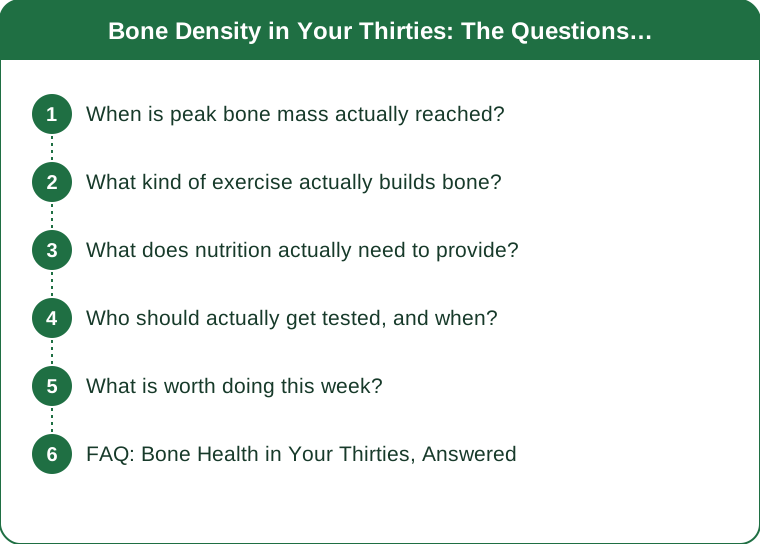
When is peak bone mass actually reached?
Earlier than nearly everyone assumes, which is why this matters now.
So the building phase is over by your thirties?
Largely, yes. Most bone mass is accumulated by the late twenties, with some sites finishing slightly later than others. That does not mean nothing can change afterwards - it means the leverage shifts from building a peak to defending one.
Does that mean training in your thirties is pointless for bone?
Not at all, and this is the misunderstanding worth correcting. Loading maintains and can modestly improve bone density at loaded sites at any age, and it strongly influences the rate of later loss. The trajectory from here is far more modifiable than the peak was.
Why does the thirties window matter specifically?
Because bone loss accelerates around the menopausal transition, and the amount you carry into that period sets your starting point. Every unit preserved now is a unit you do not have to worry about later - and the habits built in this decade tend to be the ones that persist.
None of this is urgent in the way an injury is urgent. It is quiet, cumulative, and almost entirely invisible until a scan or a fracture. Which is exactly why it gets deferred, and why raising it now is worth doing.
What kind of exercise actually builds bone?
Loading that is heavy, or impact that is fast - and not much else.
Does walking count?
Walking is excellent for many things and a weak stimulus for bone. Bone adapts to loads that exceed what it is used to, and walking is what your skeleton is already accustomed to. It helps maintain what you have far more than it builds.
What does count, then?
Two categories. Resistance training with meaningful load - squats, deadlifts, presses, and rows, done heavy enough that the last few repetitions are genuinely hard. And impact - jumping, hopping, skipping, and running, which produce rapid high forces through the skeleton.
How much impact is enough?
Less than people expect, and frequency matters more than volume. Short bouts of jumping, done several times a week, appear more effective than long sessions - bone responds to novel loading and then becomes less responsive within the same session. Ten to twenty hops, a few times a week, is a reasonable starting point for someone without joint issues.
Does swimming or cycling help?
For cardiovascular fitness, enormously. For bone, very little - both are low-impact and non-weight-bearing, which is precisely what removes the stimulus. If they are your main activity, adding two resistance sessions a week is the gap worth filling.
Is it site-specific?
Yes, and this is important. Bone adapts where it is loaded, so hip and spine loading requires exercises that load the hip and spine. Upper-body work does not protect the hip. A programme with squats, deadlifts or hinges, and some impact covers the sites that matter most.
What does nutrition actually need to provide?
Three things reliably, and one of them is usually the gap.
Is calcium the main thing?
It is necessary and it is rarely the limiting factor for people eating a varied diet. Dairy, fortified plant milks, tinned fish with bones, and leafy greens cover it for most. Supplementing above your needs does not add benefit and is worth discussing with a doctor rather than assuming.
What about vitamin D?
This is more often the actual gap, particularly at higher latitudes and through autumn and winter when sunlight is insufficient for skin synthesis. Vitamin D governs how well you absorb calcium, so a deficiency undermines an otherwise adequate intake. It is worth testing rather than guessing, and worth discussing supplementation with a doctor.
Does protein matter for bone?
More than the older advice suggested. Bone is roughly half protein by volume, and adequate protein intake is associated with better bone density and better outcomes. Spreading intake across meals rather than concentrating it in one is the practical advice.
Do I need to worry about anything reducing it?
A few things. Very low energy availability - eating substantially less than you expend for extended periods - is one of the more damaging patterns for bone, particularly when it disrupts menstrual cycles. Heavy alcohol intake and smoking both affect bone negatively. Chronic under-eating while training hard is the combination that does the most harm and it is common enough to be worth naming.

Who should actually get tested, and when?
Fewer people than are anxious about it, and more than currently do.
Should everyone in their thirties get a bone scan?
No. Routine screening at this age is not standard and would not change most people’s actions - the advice for a healthy thirty-five-year-old is the same either way: load your skeleton and eat adequately.
Who should ask about one?
Anyone with specific risk factors. A history of missed periods for extended stretches, an eating disorder, early menopause, long-term steroid use, coeliac disease or other malabsorption conditions, a fragility fracture, or a strong family history are all reasons to raise it with a doctor.
What about if I have had irregular cycles while training hard?
That is a genuine reason to have a conversation. Absent or irregular periods in the context of hard training and low energy availability is a recognised pattern with real bone consequences, and it is worth taking seriously rather than treating as a normal adaptation to training.
What would a doctor actually do?
Usually a discussion of risk factors first, blood work including vitamin D, and a scan only if it is indicated. The conversation is more useful than the scan for most people at this age. This is general information, not medical advice - the specifics belong with your own doctor.
What is worth doing this week?
A short, concrete list rather than a philosophy.
If I only change one thing?
Add two resistance sessions a week with meaningful load, including a squat or leg press pattern and a hinge or deadlift pattern. This single change addresses the hip and spine, which are the sites that matter most later.
What is the easiest addition?
Ten to twenty hops or skips, a few times a week - while the kettle boils, or at the end of a walk. It takes under a minute and it is a genuine stimulus. Skip this if you have knee, hip, or pelvic floor issues, and ask a physio for an alternative.
What should I check?
Vitamin D status, if you have never had it tested and particularly heading into autumn. It is a single blood test and it is the most common actual deficiency in this picture.
And what should I stop worrying about?
Calcium supplements, if you eat a varied diet. The evidence for supplementing beyond adequate dietary intake is not strong, and the attention is better spent on loading, which is where the leverage is.
Is it too late if I am at the end of my thirties?
No. Loading works at every age, and the rate of later loss is influenced by what you do throughout. The best time to start was your twenties; the second best is this week - which is trite and also accurate.
FAQ: Bone Health in Your Thirties, Answered
How heavy is heavy enough for bone?
Heavy enough that the last two or three repetitions of a set are genuinely difficult, working in a moderate repetition range. Light weights for high repetitions do relatively little for bone, even though they are useful for other things.
Does running protect the hip?
Running provides real impact loading and is better for bone than swimming or cycling. It does not replace resistance training for the spine and hip, but as a combination the two cover the ground well.
Can I do anything about the peak I already reached?
Not retrospectively, and that is fine - the modifiable variable from here is the rate of loss, and it is substantially modifiable. Focusing on what is still in front of you is both more accurate and more useful.
TL;DR:
- Peak bone mass is reached by around the late twenties - your thirties are about preserving it, not building it.
- Bone adapts to heavy loading and to impact. Walking, swimming, and cycling are weak stimuli.
- Two resistance sessions a week with squats and hinges, plus short bouts of hopping, covers the key sites.
- Vitamin D is the more common gap than calcium - worth testing, especially heading into autumn.
- Chronic under-eating while training hard is the pattern that does the most damage. Take irregular cycles seriously.
Add twenty hops to your week and book a vitamin D test. Two small actions with a long payoff.
Keep Reading
This article is for general informational purposes only and is not medical advice. Always consult a qualified health professional for guidance specific to you.