Does Your Metabolism Actually Crash at 30? Here's What's Really Happening
Quick Answer: Large-scale metabolic research actually shows resting metabolic rate stays fairly stable from your twenties through your late fifties — the weight changes many people notice in their thirties are more closely tied to gradually decreasing activity levels and muscle mass than to a metabolic “crash.”
You turned 30 and braced for your metabolism to fall off a cliff, the way everyone jokes it does. The research on this is actually more reassuring than the joke suggests — and understanding what’s really changing helps more than assuming decline is inevitable.

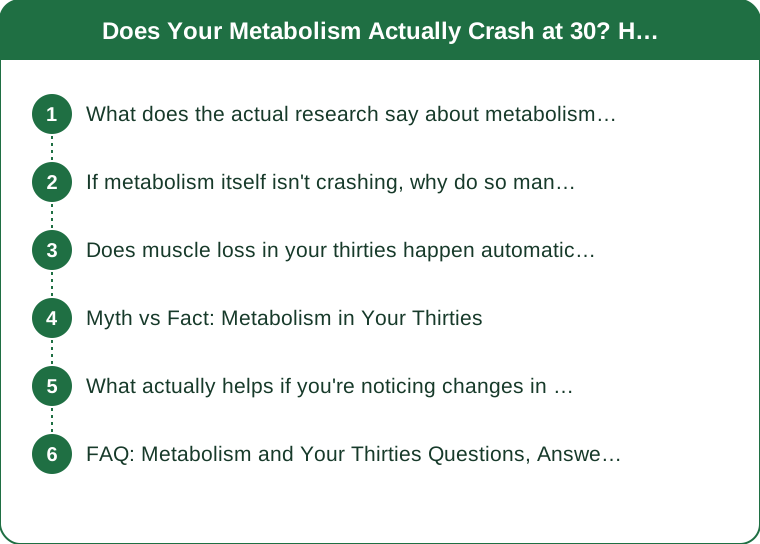
What does the actual research say about metabolism and age in your thirties?
A large 2021 study published in Science tracking metabolic rate across thousands of people found resting metabolism stays essentially flat from around age 20 to 60, with the first real natural decline not showing up until later in life than most people assume.
If metabolism itself isn’t crashing, why do so many people gain weight in their thirties?
Activity levels tend to drop gradually — less unstructured movement, more sedentary work and family responsibilities — and muscle mass slowly declines without deliberate strength training, both of which reduce total daily calorie burn even though resting metabolic rate itself hasn’t changed much.
Does muscle loss in your thirties happen automatically, or is it preventable?
Some gradual muscle loss without training is common, but it’s substantially preventable and even reversible with regular resistance training, which is one of the more directly actionable levers for offsetting the activity-related calorie burn decline that does happen.

Myth vs Fact: Metabolism in Your Thirties
Myth: Your metabolism drops sharply the moment you turn 30. Fact: research shows metabolic rate stays largely stable through this decade and well beyond.
Myth: There’s nothing you can do about it, so weight gain is inevitable. Fact: since the real driver is usually activity and muscle mass, both are meaningfully within your control.
Myth: Eating less is the main fix once metabolism “slows.” Fact: since metabolism itself often hasn’t changed much, maintaining muscle and activity levels tends to matter more than further calorie restriction.
What actually helps if you’re noticing changes in your thirties?
Maintaining or building muscle through resistance training directly counters the muscle-related decline in calorie burn. Keeping incidental daily movement up — walking, taking stairs, staying generally active — offsets the activity drop that tends to happen quietly as schedules get busier.
FAQ: Metabolism and Your Thirties Questions, Answered
Is there any age where metabolism does start dropping meaningfully?
Most research points to a more noticeable decline starting later, generally after age 60, rather than in the thirties or forties.
Does having children affect this pattern specifically?
Not metabolically on its own, but the reduced personal activity time and disrupted sleep that often come with parenting can indirectly reduce daily movement, which has a similar practical effect.
Should thirty-somethings change their calorie intake at all based on this research?
Most people don’t need to significantly cut calories based on age alone — adjustments are more usefully driven by actual activity level and muscle mass than by assumed metabolic decline.
TL;DR:
- Large-scale research shows resting metabolism stays largely stable from your twenties through your fifties
- Weight changes in your thirties are more closely tied to activity level and muscle mass than metabolism itself
- Both of those drivers are meaningfully within your control through training and daily movement
- A real metabolic decline tends to show up later, generally after 60, not in your thirties
The thirty-and-your-metabolism-crashes idea is more myth than fact — what’s actually shifting is easier to influence than a mysterious metabolic slowdown would be.
Keep Reading
This article is for general informational purposes only and is not medical advice. Always consult a qualified health professional for guidance specific to you.