Do You Really Need to Train Differently in Your Thirties? The Honest Answer
Quick Answer: Yes, but less than the internet makes it sound. Recovery time genuinely lengthens and injury risk from sudden volume increases genuinely rises — but your capacity for strength, endurance, and fat loss doesn’t meaningfully decline in your thirties. The main shift is in how you recover and progress, not in what your body is capable of.
Somewhere around 30, a specific kind of panic sets in: is my metabolism about to collapse? Do I need to completely rebuild my routine? The honest answer is more boring and more useful than the alarming headlines suggest.

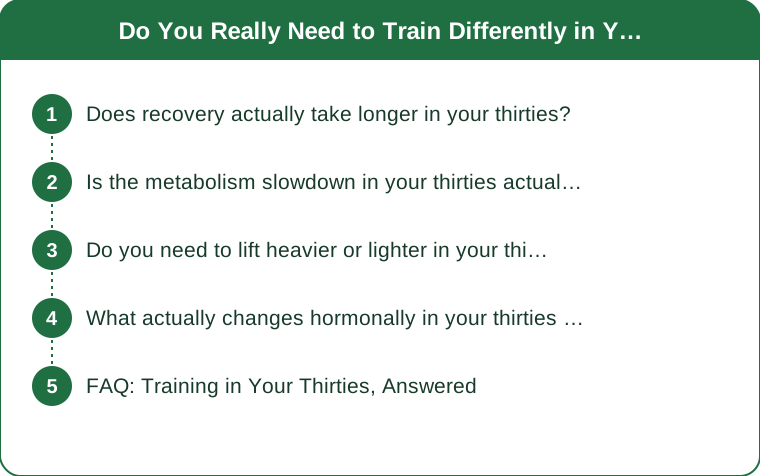
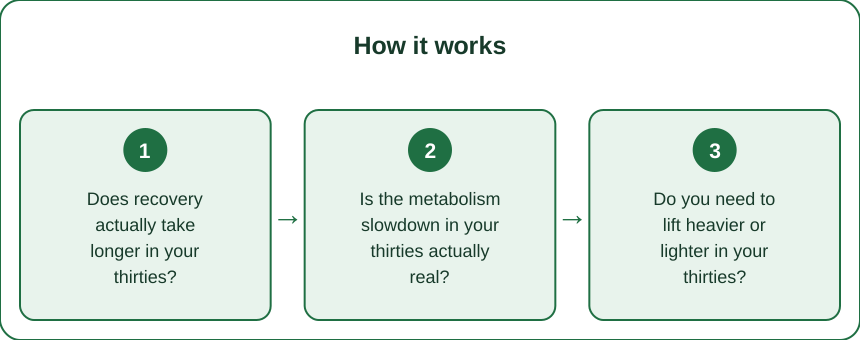
Does recovery actually take longer in your thirties?
Yes, measurably — but the change is gradual, not a cliff at your 30th birthday. Studies on recovery markers show roughly 10-20% longer recovery time between hard sessions by the late thirties compared to the early twenties, mostly due to slightly reduced growth hormone output and accumulated joint wear from years of training.
This doesn’t mean you need more rest days across the board — it means the specific session that used to need 24 hours might now need 36-48, particularly after heavy leg days or high-impact cardio. Tracking your own soreness pattern for a month tells you more than any general rule.
Is the metabolism slowdown in your thirties actually real?
The slowdown is real but small — typically 1-2% per decade starting in your twenties, which is nowhere near the dramatic ‘everything changes at 30’ narrative. The bigger factor is usually a gradual decrease in daily movement (less walking, more sedentary work) rather than a biological metabolic cliff.
The practical fix isn’t a diet overhaul — it’s maintaining or slightly increasing strength training to preserve the muscle mass that drives most of your resting metabolic rate in the first place.

Do you need to lift heavier or lighter in your thirties?
Neither, by default — you need to lift more consistently with better technique, because the cost of a sloppy heavy rep (in terms of recovery and injury risk) is higher than it was a decade ago. This isn’t about going lighter across the board; it’s about being more deliberate with warm-up sets and not skipping deload weeks the way you might have gotten away with at 24.
What actually changes hormonally in your thirties that affects training?
For most women, hormonal shifts in the thirties are subtle and individual rather than universal — some notice slightly more energy fluctuation across the menstrual cycle, some notice none at all. The biggest practical change is sleep quality, which affects recovery, appetite regulation, and workout performance far more directly than any hormone shift specific to turning 30.
If workouts suddenly feel harder for no clear reason, checking sleep consistency first is more useful than assuming a hormonal cause.
FAQ: Training in Your Thirties, Answered
Should I switch from HIIT to lower-impact workouts in my thirties?
Not automatically. If your joints tolerate HIIT well and recovery is adequate, there’s no biological reason to stop. Switch only if you’re noticing recurring joint pain, not just because of your age.
Is it too late to start strength training in your thirties?
No — strength gains in your thirties follow essentially the same trajectory as in your twenties for someone new to lifting. The ‘too late’ narrative isn’t supported by the research on training adaptation.
Why do workouts that used to be easy suddenly feel harder?
Usually it’s a recovery deficit (poor sleep, higher life stress, insufficient protein) rather than an age-related capacity drop. Address the recovery variables before assuming your body has fundamentally changed.
TL;DR:
- Recovery time increases modestly (10-20%) in your thirties — plan slightly more rest after your hardest sessions
- Metabolic slowdown is real but small (1-2% per decade), not the dramatic shift people expect
- Strength training remains just as effective for building muscle in your thirties as in your twenties
- If workouts suddenly feel harder, check sleep and recovery before assuming an age-related decline
Most of what changes in your thirties is about paying closer attention, not starting over.
Keep Reading
This article is for general informational purposes only and is not medical advice. Always consult a qualified health professional for guidance specific to you.